谈
Character Story & Explanation
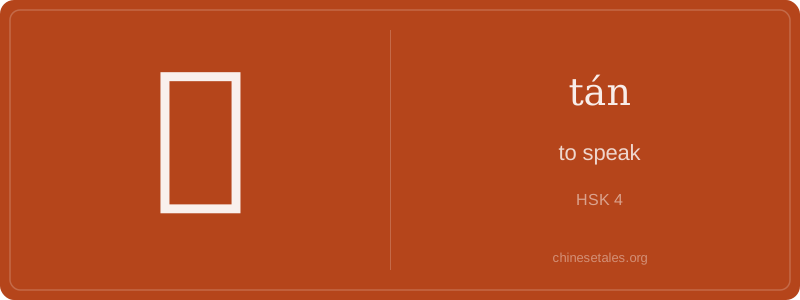
The earliest form of 谈 appears in seal script as 言+炎—‘speech’ (言) combined with ‘flame’ (炎), not as fire, but as a phonetic clue (yán was pronounced similarly to tán in Old Chinese). The left side 讠 (yán bàng) is the modern shorthand for 言, the ‘speech’ radical that appears in all language-related characters like 说 (shuō, ‘to speak’) and 讲 (jiǎng, ‘to explain’). The right side, 炎, evolved from two stacked ‘fire’ components, but here it served purely as a sound hint—not meaning ‘burning talk’, but anchoring the pronunciation. Over centuries, 炎 simplified into 占, losing its flame shape but keeping its phonetic role (both 占 and 谈 share the -an rhyme and similar historical tones).
This visual fusion reflects how Chinese writing prioritizes function over literal imagery: the character doesn’t depict mouths or voices—it signals *purposeful verbal exchange*. By the Han dynasty, 谈 appears in the classic text *Shuō Yuàn* (Garden of Stories), where scholars ‘清谈’ (qīng tán, ‘pure talk’)—elegant, abstract philosophical discussions detached from politics. Later, during the Wei-Jin period, qīng tán became a cultural obsession: elite men would gather, sip tea, and engage in witty, paradox-rich dialogues, elevating 谈 from simple ‘speaking’ to intellectual artistry. Even today, the stroke order (starting with the dot of 讠, then the three strokes of 占) mirrors this idea: first, the intention to speak; then, the substance—the claim, the point, the shared ground.
Think of 谈 (tán) as the Chinese equivalent of a well-moderated town hall meeting—not just 'speaking', but speaking *with intent*: to discuss, negotiate, or exchange ideas. Unlike English ‘speak’, which can be monologic (‘He spoke for an hour’), 谈 implies reciprocity and purpose—two or more people actively engaging. You wouldn’t say 我谈 (wǒ tán) alone in your room; it’s almost always 跟…谈 (gēn… tán, ‘talk with…’) or about something: 谈工作 (tán gōngzuò, ‘discuss work’). It’s the verb you’d use when brokering a deal, debating philosophy, or even gently scolding your child—not shouting, but calmly addressing.
Grammatically, 谈 is transitive and rarely stands alone. It loves objects (谈计划, tán jìhuà) and prepositional phrases (跟老师谈, gēn lǎoshī tán). Learners often mistakenly use it like ‘say’ (说 shuō) or ‘talk’ (讲话 jiǎnghuà), leading to awkward sentences like *我谈了三分钟 (wǒ tán le sān fēnzhōng)—which sounds like ‘I conducted a three-minute discussion’ (with whom? about what?). Instead, say 我讲了三分钟 (wǒ jiǎng le sān fēnzhōng). Also, note: 谈 never takes aspect markers like 过 (guò) or 着 (zhe); it’s inherently event-oriented, not durative.
Culturally, 谈 carries quiet authority—it appears in formal contexts like 谈判 (tánpàn, ‘negotiation’) and 谈心 (tánxīn, ‘heart-to-heart talk’), where emotional honesty and mutual respect are assumed. In classical texts, Confucius praised those who ‘言而有信,谈而不躁’ (yán ér yǒu xìn, tán ér bù zào)—‘speak with trustworthiness, discuss without agitation’. That calm, considered tone still echoes today: if someone says 我们谈谈吧 (wǒmen tán tan ba), they’re not chit-chatting—they’re inviting resolution.