女
Character Story & Explanation
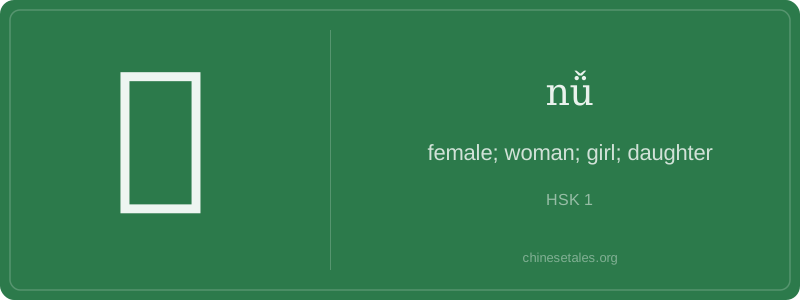
The earliest form of 女 appears on Shang dynasty oracle bones (c. 1200 BCE) as a graceful pictograph: a kneeling woman with bent arms and long hair flowing down — her posture humble yet dignified, knees tucked beneath her, hands resting gently forward. Over centuries, the ‘kneeling’ stance simplified: the two downward strokes became the left and right ‘folds’ of her robe, and the central stroke curved into her torso and head. By the seal script era, it had settled into three distinct strokes — a dot-like head, a sweeping left ‘arm’, and a mirrored right ‘arm’ — all converging in quiet balance. No legs, no face — just essence: presence, grace, groundedness.
This ancient pose wasn’t passive — in early ritual contexts, kneeling signaled respect, receptivity, and cosmic alignment (earth below, heaven above). The character thus encoded not biology but role: nurturer, keeper of hearth, bridge between generations. In the *Book of Songs*, ‘nǚ’ appears in tender odes to brides and mothers; by the Han dynasty, it was already the foundational radical for words like ‘mǔ’ (mother) and ‘zǐ’ (child), confirming its centrality to kinship structure. Visually, those three strokes still echo that original silhouette — a woman poised, present, and quietly powerful.
Imagine you're at a bustling Beijing hutong teahouse, and an elderly auntie points to her granddaughter playing hopscotch: 'Zhè shì wǒ de nǚ'ér!' — that little girl is the living heart of 女 (nǚ). This character isn’t just a neutral label for ‘female’ — it pulses with relational warmth and social positioning. In Chinese, 女 carries subtle weight: it’s rarely used alone in speech (you’d say ‘nǚrén’ or ‘nǚhái’, not just ‘nǚ’), but it’s the indispensable radical anchoring hundreds of gendered terms — from ‘nǚshēng’ (female student) to ‘nǚshì’ (lady). It’s also the first syllable in polite address like ‘nǚshì’ (ma’am), where tone and context do heavy lifting.
Grammatically, 女 shines as a prefix — never a standalone noun in modern spoken Mandarin. You’ll see it in compound nouns (nǚbàn — female companion), adjectives (nǚxìng — feminine), and even verbs (nǚbàn — to accompany as a woman, though rare). Learners often mistakenly use 女 alone like English ‘woman’ — but that’s unnatural; think of it more like the English root ‘-ess’ in ‘actress’ or ‘hostess’: essential, but never unattached.
Culturally, 女 reflects both reverence and constraint: Confucian texts like the *Nü Sishu* (Four Books for Women) codified its moral weight, while today’s young women reclaim it proudly in phrases like ‘nǚquán’ (women’s rights). A classic trap? Writing 女 with too many strokes — remember: just three elegant, flowing lines. And don’t confuse it with ‘nǐ’ (you) — tones matter!