质
Character Story & Explanation
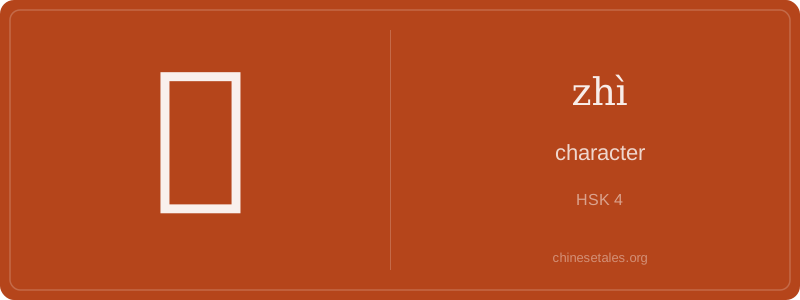
The earliest form of 质 (in bronze inscriptions, c. 1000 BCE) shows a person (人) standing under a shelter-like roof (厂), holding a small object — possibly a ritual token or pledge. Over centuries, the person simplified into the left-side component 罒 (a variant of 网, 'net', later misinterpreted as 'eye' but originally signifying 'binding agreement'), while the roof (厂) remained as the radical — evoking protection, enclosure, and contractual space. By the Han dynasty, strokes standardized: the top 厂 (cliff/shelter), then three horizontal lines (representing layered pledges or sealed documents), and finally the bottom 贝 (bèi, 'cowrie shell', ancient currency symbolizing value exchanged). Eight strokes total — each one a layer of commitment.
This visual history shaped its meaning: 质 originally meant 'pledge' or 'hostage' — a person or object given as security in ancient treaties. From there, it evolved to mean 'intrinsic value' (what’s pledged must be real), then 'essential nature' (what remains when all surface trappings are stripped away). In the Mencius, 质 appears in legal contexts — 'questioning evidence' — reinforcing its link to verification. Even today, 质疑 (zhìyí) preserves that ancient sense: to demand proof, like a duke demanding his pledged hostage be produced before trusting an ally.
Think of 质 (zhì) as Chinese philosophy’s version of a ‘truth serum’ — not for interrogations, but for cutting through appearances to reveal what something *truly is* beneath the surface. In English, ‘character’ often suggests moral fiber or personality, but 质 goes deeper: it’s about *essential nature*, like asking ‘What is this thing *made of*?’ or ‘What’s its fundamental substance?’ That’s why it appears in physics (物质 wùzhì, 'matter'), ethics (品质 pǐnzhì, 'moral quality'), and even customer service (质疑 zhìyí, 'to question the validity of').
Grammatically, 质 rarely stands alone — it’s almost always paired: as the second character in two-syllable nouns (本质 běnzhì 'essence'), or in compound verbs like 质疑 (zhìyí, 'to challenge') where it carries the weight of critical scrutiny. Learners often mistakenly use it like English ‘character’ in personal descriptions ('He has strong character' → *他有强质?* ❌), but native speakers say 他很有品格 (tā hěn yǒu pǐngé) or 他性格坚强 (tā xìnggé jiānqiáng). 质 needs company — and meaning — to shine.
Culturally, 质 echoes Daoist and Confucian preoccupations with authenticity versus ornamentation. The Analects praises ‘质胜文则野’ — 'If substance dominates form, one becomes rustic' — warning that raw sincerity without refinement isn’t enough. A common learner trap? Overusing 质 in writing to sound profound, when simpler words like 特点 (tèdiǎn, 'feature') or 核心 (hékōnɡ, 'core') fit better. Remember: 质 isn’t flashy — it’s the quiet, unyielding core you test by fire.