Word Explanation
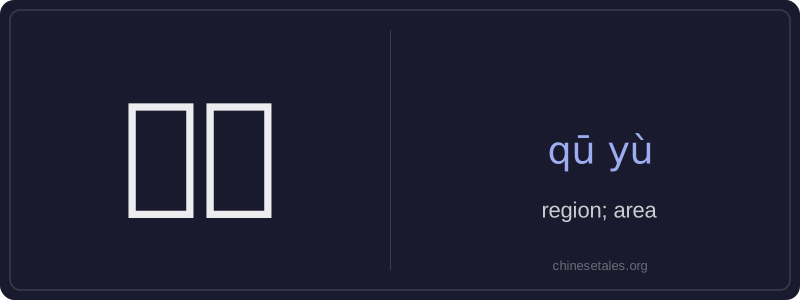
‘區域’ (qū yù) is a compound noun meaning 'region' or 'area'—a defined geographical or functional space. The first character 區 (qū) means 'district' or 'zone', often implying administrative or conceptual division, while 域 (yù) means 'domain', 'realm', or 'territory', emphasizing scope or boundary. Together, they convey a sense of a bounded, identifiable space—whether physical (like a mountain region), administrative (a special economic zone), or abstract (a research domain).
This word is formal and neutral in register, commonly used in news, geography, policy documents, and academic contexts. It’s more precise and official-sounding than simpler alternatives like 地方 (dìfāng) or 地區 (dìqū). You’ll often see it in compound terms such as ‘生態區域’ (ecological region), ‘發展區域’ (development area), or ‘文化區域’ (cultural region). Unlike colloquial terms, 區域 rarely appears in casual speech unless referring to maps, planning, or institutional frameworks.
Example Sentences
Related Words
国语
‘Guó yǔ’ literally means 'national language'—
无论谁
‘无论谁’ (wú lùn shéi) is a pronoun meaning
外语
‘外语’ literally means ‘outside language’ —
面条
‘面条’ (miàn tiáo) literally means ‘flour str
不对
不对 (bù duì) literally combines 不 (bù), meani
认为
‘认为’ (rèn wéi) is a transitive verb meaning
认同
‘认同’ (tóng rèn) is a verb meaning ‘to ident
中学
'Zhōngxué' literally combines 'zhōng' (middle)