Word Explanation
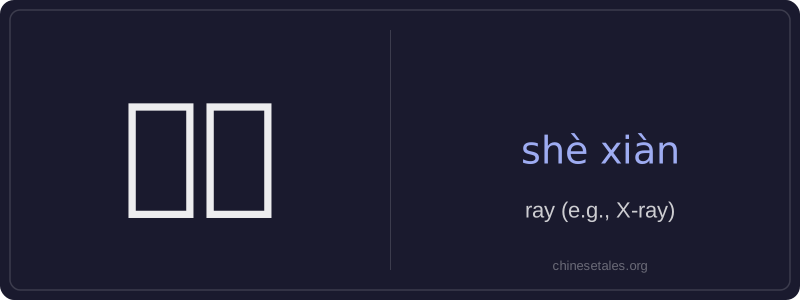
‘射线’ (shè xiàn) literally combines ‘射’ (to shoot, emit) and ‘线’ (line, ray), forming a scientific term meaning 'ray' — especially in physics and medicine. It refers to streams of energy or particles traveling in straight lines, such as X-rays, gamma rays, or cosmic rays. Unlike the English word 'ray' used in geometry (e.g., light ray), 射线 in Chinese almost always carries a technical, often medical or physical, connotation.
The term appears frequently in healthcare contexts (e.g., X-ray imaging, radiation therapy) and scientific education. It is rarely used metaphorically or in casual speech. While ‘光线’ (guāngxiàn) means ‘light ray’ in everyday contexts, 射线 specifically denotes ionizing or high-energy radiation. Learners should avoid substituting it for general terms like ‘beam’ or ‘line’ unless referring to scientifically defined radiation.
Example Sentences
Related Words
国语
‘Guó yǔ’ literally means 'national language'—
无论谁
‘无论谁’ (wú lùn shéi) is a pronoun meaning
外语
‘外语’ literally means ‘outside language’ —
面条
‘面条’ (miàn tiáo) literally means ‘flour str
不对
不对 (bù duì) literally combines 不 (bù), meani
认为
‘认为’ (rèn wéi) is a transitive verb meaning
认同
‘认同’ (tóng rèn) is a verb meaning ‘to ident
中学
'Zhōngxué' literally combines 'zhōng' (middle)