Word Explanation
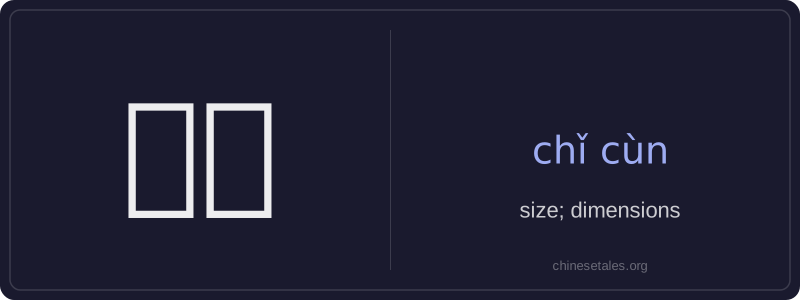
尺寸 literally combines two traditional Chinese units of length: 尺 (chǐ, approx. 33 cm) and 寸 (cùn, approx. 3.3 cm). Historically, it referred to precise linear measurements, but today it functions as a general noun meaning 'size' or 'dimensions' — especially for objects with measurable length, width, and height. It’s commonly used when specifying physical specifications, such as for clothing, furniture, screens, or packaging.
The word is neutral in register and appears frequently in both spoken and written Chinese, particularly in shopping, manufacturing, design, and logistics contexts. Unlike the more abstract term 大小 (dàxiǎo, 'size' in a relative or qualitative sense), 尺寸 emphasizes objective, quantifiable measurement. It’s typically used with measure words like 个 or without any, and often follows verbs like 知道 (zhīdào, 'to know'), 测量 (cèliáng, 'to measure'), or 改变 (gǎibiàn, 'to change').
Example Sentences
Related Words
国语
‘Guó yǔ’ literally means 'national language'—
无论谁
‘无论谁’ (wú lùn shéi) is a pronoun meaning
外语
‘外语’ literally means ‘outside language’ —
面条
‘面条’ (miàn tiáo) literally means ‘flour str
不对
不对 (bù duì) literally combines 不 (bù), meani
认为
‘认为’ (rèn wéi) is a transitive verb meaning
认同
‘认同’ (tóng rèn) is a verb meaning ‘to ident
中学
'Zhōngxué' literally combines 'zhōng' (middle)