Word Explanation
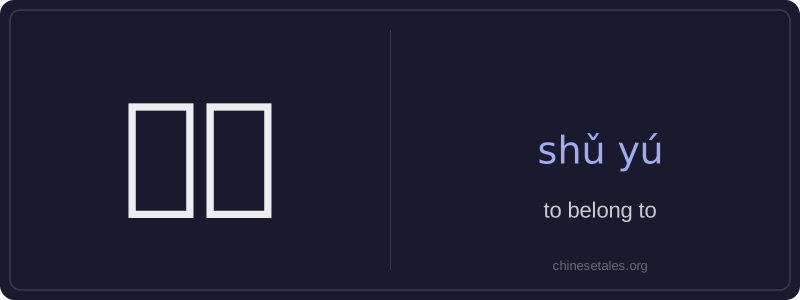
属于 (shǔ yú) is a two-character verb meaning 'to belong to' — expressing ownership, membership, classification, or affiliation. The first character 属 (shǔ) originally means 'to be affiliated with' or 'to be under the jurisdiction of', while 于 (yú) is a classical preposition indicating direction or relation; together, they form a fixed compound used exclusively in this sense. Unlike English 'belong to', 属于 is not used with continuous or progressive aspects and never takes aspectual particles like 了 or 过.
This verb is commonly used in formal, academic, or administrative contexts — for instance, when stating nationality, organizational membership, tax categories, biological taxonomy, or property rights. It typically follows the subject and precedes the noun phrase indicating the group, category, or owner (e.g., 'this book belongs to me' → 这本书属于我). It does not function as a standalone noun or adjective and cannot be reduplicated or modified by degree adverbs like 很.
Example Sentences
Related Words
国语
‘Guó yǔ’ literally means 'national language'—
无论谁
‘无论谁’ (wú lùn shéi) is a pronoun meaning
外语
‘外语’ literally means ‘outside language’ —
面条
‘面条’ (miàn tiáo) literally means ‘flour str
不对
不对 (bù duì) literally combines 不 (bù), meani
认为
‘认为’ (rèn wéi) is a transitive verb meaning
认同
‘认同’ (tóng rèn) is a verb meaning ‘to ident
中学
'Zhōngxué' literally combines 'zhōng' (middle)