Word Explanation
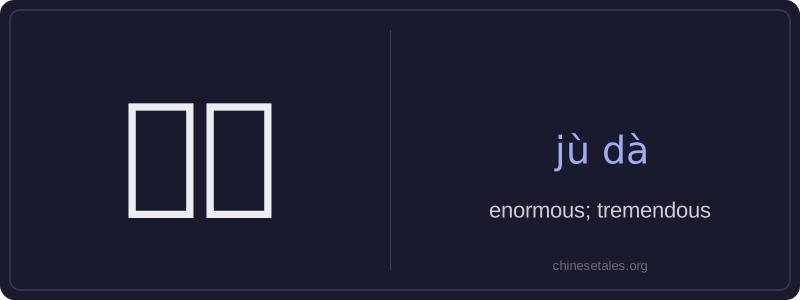
巨大 (jù dà) is an adjective meaning 'enormous' or 'tremendous', emphasizing extreme size, scale, or degree. It combines 巨 (jù), meaning 'giant' or 'monumental', and 大 (dà), meaning 'big' or 'large'. Together, they form a compound that intensifies the idea of bigness beyond ordinary proportion — not just big, but strikingly, impressively large. Unlike simpler words like 大 or 很大, 巨大 carries a formal or literary tone and often appears in written Chinese, news reports, scientific descriptions, or dramatic speech.
This word frequently modifies nouns directly (e.g., 巨大的动物, 巨大的影响) and can also function predicatively with 是 or other copulas (e.g., 这个问题非常巨大). It’s commonly used to describe physical scale (e.g., animals, structures, natural phenomena) as well as abstract concepts like impact, effort, or risk — always implying magnitude that evokes awe or significance.
Example Sentences
Related Words
国语
‘Guó yǔ’ literally means 'national language'—
无论谁
‘无论谁’ (wú lùn shéi) is a pronoun meaning
外语
‘外语’ literally means ‘outside language’ —
面条
‘面条’ (miàn tiáo) literally means ‘flour str
不对
不对 (bù duì) literally combines 不 (bù), meani
认为
‘认为’ (rèn wéi) is a transitive verb meaning
认同
‘认同’ (tóng rèn) is a verb meaning ‘to ident
中学
'Zhōngxué' literally combines 'zhōng' (middle)