Word Explanation
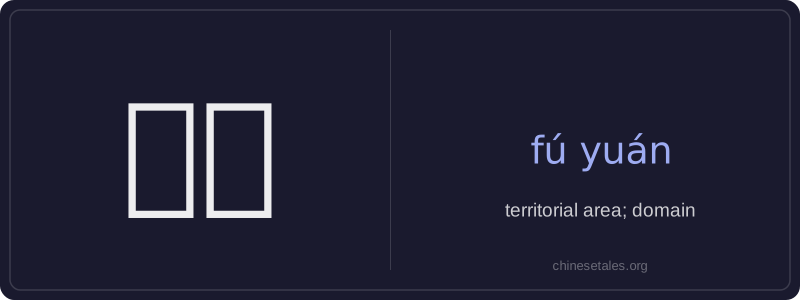
幅员 (fú yuán) is a formal literary noun meaning 'territorial area' or 'domain', referring to the total land area under a country’s, region’s, or administrative unit’s jurisdiction. The character 幅 originally meant 'width' or 'breadth' (as in a scroll’s width), and 员 here functions as an archaic variant of 域 (yù, 'territory' or 'realm'), not the modern word for 'staff member'. Together, they evoke the idea of the full spatial extent — length and breadth — of a governed space.
This term appears almost exclusively in formal, descriptive, or historical contexts: official documents, geography textbooks, news reports about national boundaries, or historical accounts comparing imperial domains. It carries a dignified, slightly classical tone and is rarely used in casual speech. Unlike more neutral terms like 面积 (miàn jī, 'area') or 领土 (lǐng tǔ, 'territory'), 幅员 emphasizes the comprehensive, bounded expanse of sovereign control — often highlighting vastness or historical continuity.
Example Sentences
Related Words
国语
‘Guó yǔ’ literally means 'national language'—
无论谁
‘无论谁’ (wú lùn shéi) is a pronoun meaning
外语
‘外语’ literally means ‘outside language’ —
面条
‘面条’ (miàn tiáo) literally means ‘flour str
不对
不对 (bù duì) literally combines 不 (bù), meani
认为
‘认为’ (rèn wéi) is a transitive verb meaning
认同
‘认同’ (tóng rèn) is a verb meaning ‘to ident
中学
'Zhōngxué' literally combines 'zhōng' (middle)