Word Explanation
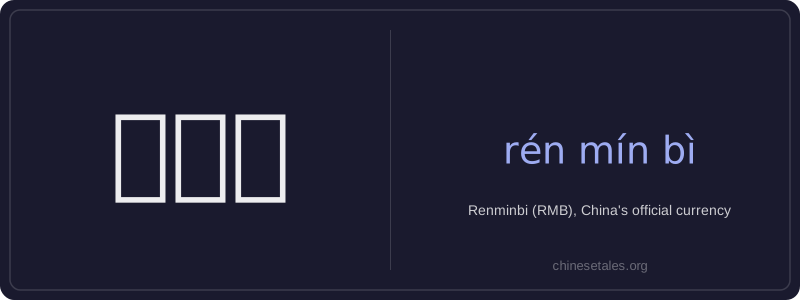
Renminbi (RMB), literally meaning 'people's currency', is the official currency of the People's Republic of China. The three characters break down as follows: 人 (rén) means 'person' or 'people', 民 (mín) also means 'people' or 'citizen', and 币 (bì) means 'currency' or 'coin'. Together, they emphasize that this money belongs to and serves the Chinese people. It is issued by the People's Bank of China and used in all financial transactions across mainland China.
RMB is often abbreviated as ¥ or CNY (China Yuan) internationally, while domestically it’s commonly referred to simply as 元 (yuán), the basic unit—similar to how 'dollar' is used for USD. Although 'yuan' names the unit, 'renminbi' refers to the currency system itself, much like 'euro' vs. 'euro cent'. It’s used formally in banking, news, legal documents, and economic discussions, and appears on banknotes, coins, and digital payment platforms.
Example Sentences
Related Words
国语
‘Guó yǔ’ literally means 'national language'—
无论谁
‘无论谁’ (wú lùn shéi) is a pronoun meaning
外语
‘外语’ literally means ‘outside language’ —
面条
‘面条’ (miàn tiáo) literally means ‘flour str
不对
不对 (bù duì) literally combines 不 (bù), meani
认为
‘认为’ (rèn wéi) is a transitive verb meaning
认同
‘认同’ (tóng rèn) is a verb meaning ‘to ident
中学
'Zhōngxué' literally combines 'zhōng' (middle)