Word Explanation
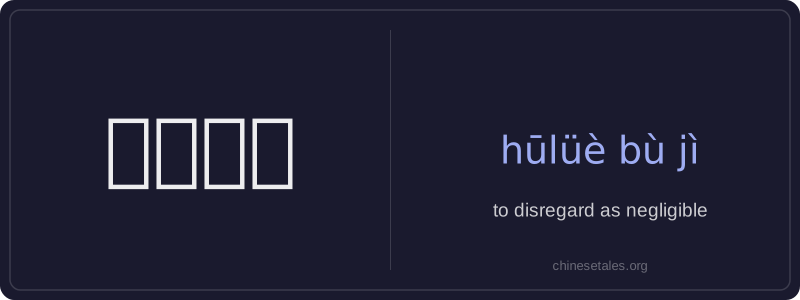
忽略不计 is a four-character verb meaning 'to disregard as negligible' or 'to ignore because it is too small or insignificant to matter.' Literally, 忽 (hū) means 'to overlook,' 略 (lüè) means 'to omit' or 'to skip,' 不 (bù) is the negation particle, and 计 (jì) means 'to count' or 'to calculate.' Together, they form an idiom expressing the deliberate decision to exclude something from consideration due to its trivial size, value, or impact.
This phrase is commonly used in formal, quantitative, or analytical contexts — especially when discussing measurements, statistics, margins of error, time intervals, or financial figures. It implies a reasoned judgment, not carelessness: the speaker acknowledges the existence of the element but deems it irrelevant for practical or logical purposes. It often appears after numerical expressions (e.g., '0.01%') or with phrases like '可忽略不计' (can be disregarded).
Example Sentences
Related Words
国语
‘Guó yǔ’ literally means 'national language'—
无论谁
‘无论谁’ (wú lùn shéi) is a pronoun meaning
外语
‘外语’ literally means ‘outside language’ —
面条
‘面条’ (miàn tiáo) literally means ‘flour str
不对
不对 (bù duì) literally combines 不 (bù), meani
认为
‘认为’ (rèn wéi) is a transitive verb meaning
认同
‘认同’ (tóng rèn) is a verb meaning ‘to ident
中学
'Zhōngxué' literally combines 'zhōng' (middle)