Word Explanation
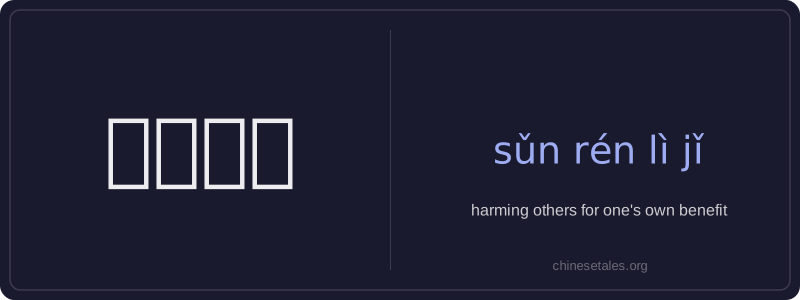
‘损人利己’ literally means ‘harm others and benefit oneself’. It describes selfish, unethical behavior where someone gains advantage by causing harm, loss, or inconvenience to others. Each character contributes directly: 损 (sǔn) means ‘to damage’ or ‘to harm’, 人 (rén) means ‘people’ or ‘others’, 利 (lì) means ‘to benefit’ or ‘to profit’, and 己 (jǐ) means ‘oneself’. Together, the phrase forms a compact, four-character idiom (chéngyǔ) that carries strong moral disapproval.
This term is commonly used in formal speech, writing, and moral education to condemn exploitative, dishonest, or ruthless conduct — such as cheating on exams to get ahead, stealing credit for a colleague’s work, or cutting corners in manufacturing at the expense of consumer safety. While it functions grammatically as both a noun (e.g., ‘this is pure 损人利己’) and an adjective (e.g., ‘a 损人利己 act’), it is rarely used positively and almost always implies criticism or condemnation.
Example Sentences
Related Words
国语
‘Guó yǔ’ literally means 'national language'—
无论谁
‘无论谁’ (wú lùn shéi) is a pronoun meaning
外语
‘外语’ literally means ‘outside language’ —
面条
‘面条’ (miàn tiáo) literally means ‘flour str
不对
不对 (bù duì) literally combines 不 (bù), meani
认为
‘认为’ (rèn wéi) is a transitive verb meaning
认同
‘认同’ (tóng rèn) is a verb meaning ‘to ident
违规
违规 (wéi guī) literally means 'to violate rules