Word Explanation
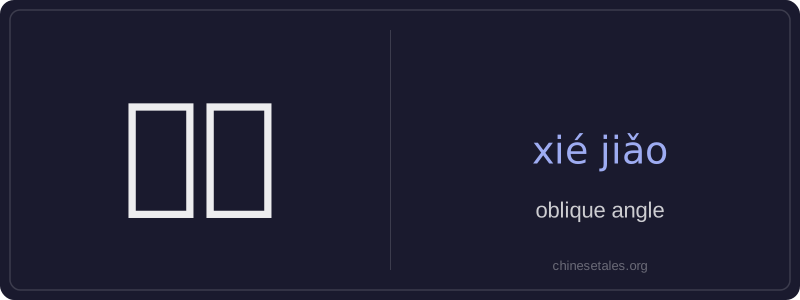
‘斜角’ (xié jiǎo) literally combines ‘斜’ (xié), meaning ‘slanted’ or ‘oblique’, and ‘角’ (jiǎo), meaning ‘angle’. Together, it refers to an angle that is neither right (90°) nor straight (180°), but falls somewhere between — typically any acute (less than 90°) or obtuse (greater than 90° but less than 180°) angle. It emphasizes the non-orthogonal, diagonal orientation of lines or surfaces.
This term appears frequently in geometry, engineering, architecture, and design contexts — for instance, when describing the tilt of a roof, the slant of a camera shot, or the arrangement of leaves on a stem (phyllotaxis). While technically precise, ‘斜角’ is more commonly used in technical or descriptive writing than in casual speech, where simpler terms like ‘斜的’ (slanted) or ‘歪的’ (crooked) may suffice. It carries a neutral, objective tone and is not idiomatic or metaphorical.
Example Sentences
Related Words
国语
‘Guó yǔ’ literally means 'national language'—
无论谁
‘无论谁’ (wú lùn shéi) is a pronoun meaning
外语
‘外语’ literally means ‘outside language’ —
面条
‘面条’ (miàn tiáo) literally means ‘flour str
不对
不对 (bù duì) literally combines 不 (bù), meani
认为
‘认为’ (rèn wéi) is a transitive verb meaning
认同
‘认同’ (tóng rèn) is a verb meaning ‘to ident
违规
违规 (wéi guī) literally means 'to violate rules