Word Explanation
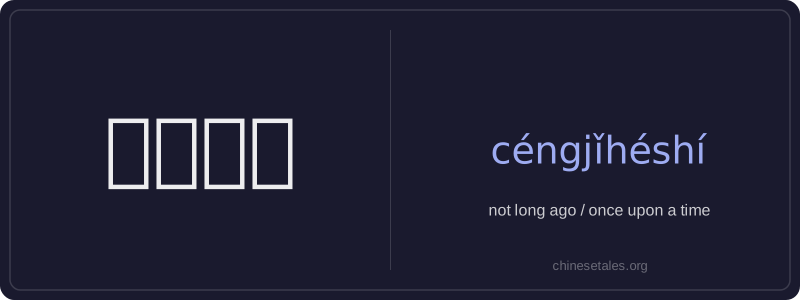
‘曾几何时’ is a literary, slightly formal adverb meaning ‘not long ago’ or ‘once upon a time’—often with a nostalgic, reflective, or even ironic tone. Literally, it breaks down as: 曾 (céng) ‘once, already’, 几 (jǐ) ‘how many’, 何 (hé) ‘what’, and 时 (shí) ‘time’—together forming a rhetorical question meaning ‘At what time did it happen?’, implying ‘It was only recently…’ The phrase evokes a sense of sudden change or contrast between past and present, frequently introducing a shift in circumstance.
It commonly appears at the beginning of a sentence, followed by a clause describing how things used to be, then contrasted with how they are now. Though grammatically adverbial, it functions more like a discourse marker signaling temporal transition and emotional resonance. It’s common in essays, speeches, and written narratives—but rare in casual speech. Learners should note it’s not interchangeable with simple time words like ‘以前’ (yǐqián); its nuance lies in implied brevity and poignancy.
Example Sentences
Related Words
国语
‘Guó yǔ’ literally means 'national language'—
无论谁
‘无论谁’ (wú lùn shéi) is a pronoun meaning
外语
‘外语’ literally means ‘outside language’ —
面条
‘面条’ (miàn tiáo) literally means ‘flour str
不对
不对 (bù duì) literally combines 不 (bù), meani
认为
‘认为’ (rèn wéi) is a transitive verb meaning
认同
‘认同’ (tóng rèn) is a verb meaning ‘to ident
违规
违规 (wéi guī) literally means 'to violate rules