Word Explanation
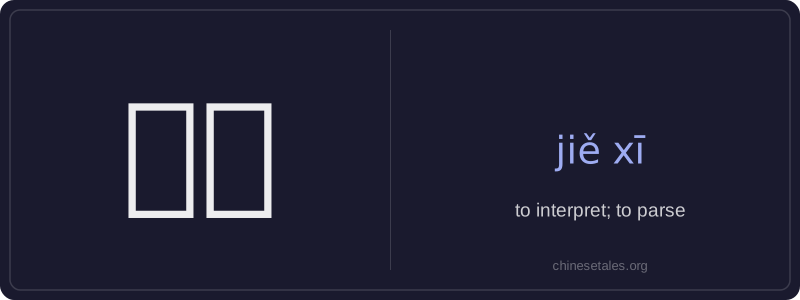
解析 (jiě xī) is a formal verb meaning 'to interpret' or 'to parse' — especially when breaking down something complex into its constituent parts for understanding. The first character 解 (jiě) means 'to untie', 'to dissolve', or 'to explain'; the second character 析 (xī) means 'to separate', 'to analyze', or 'to examine closely'. Together, they convey the idea of carefully disassembling and explaining a structure — whether it's a sentence, a mathematical problem, a computer program, or a scientific phenomenon.
This word is commonly used in academic, technical, and professional contexts: linguistics (e.g., parsing grammar), computer science (e.g., parsing code syntax), mathematics (e.g., analyzing functions), and data science (e.g., interpreting datasets). It carries a tone of precision and intellectual rigor, and is rarely used in casual speech. While 解 alone can mean 'to understand' or 'to solve', adding 析 emphasizes methodical, step-by-step examination rather than intuitive comprehension.
Example Sentences
Related Words
国语
‘Guó yǔ’ literally means 'national language'—
无论谁
‘无论谁’ (wú lùn shéi) is a pronoun meaning
外语
‘外语’ literally means ‘outside language’ —
面条
‘面条’ (miàn tiáo) literally means ‘flour str
不对
不对 (bù duì) literally combines 不 (bù), meani
认为
‘认为’ (rèn wéi) is a transitive verb meaning
认同
‘认同’ (tóng rèn) is a verb meaning ‘to ident
违规
违规 (wéi guī) literally means 'to violate rules