Word Explanation
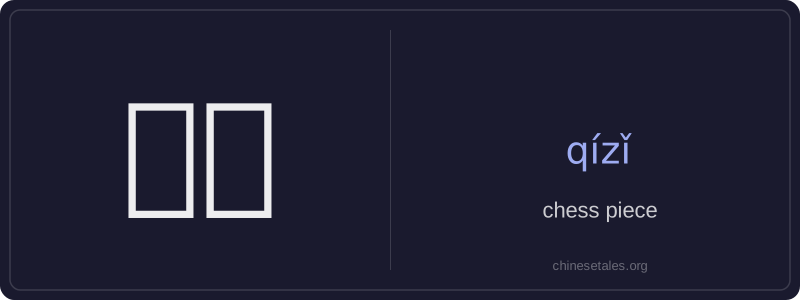
‘棋子’ literally means ‘chess piece’—a small object used in board games like Chinese chess (xiàngqí), Go (wéiqí), or Western chess. The first character 棋 (qí) refers to ‘board game’ or ‘chess’ in general, while 子 (zǐ) is a common noun suffix meaning ‘piece’, ‘object’, or ‘small item’. Together, they form a compound noun denoting any discrete playing piece in strategic board games.
Although ‘棋子’ most commonly appears in discussions of traditional Chinese games, it’s also used metaphorically to describe people who are manipulated by others—like pawns in politics or business—though this figurative use carries a negative connotation. In everyday contexts, it’s neutral and concrete: you might count, move, capture, or store 棋子 during gameplay. It’s a countable noun and typically appears with measure words like 个 (gè) or 枚 (méi), especially for smaller, distinct pieces.
Example Sentences
Related Words
国语
‘Guó yǔ’ literally means 'national language'—
无论谁
‘无论谁’ (wú lùn shéi) is a pronoun meaning
外语
‘外语’ literally means ‘outside language’ —
面条
‘面条’ (miàn tiáo) literally means ‘flour str
不对
不对 (bù duì) literally combines 不 (bù), meani
认为
‘认为’ (rèn wéi) is a transitive verb meaning
认同
‘认同’ (tóng rèn) is a verb meaning ‘to ident
违规
违规 (wéi guī) literally means 'to violate rules