Word Explanation
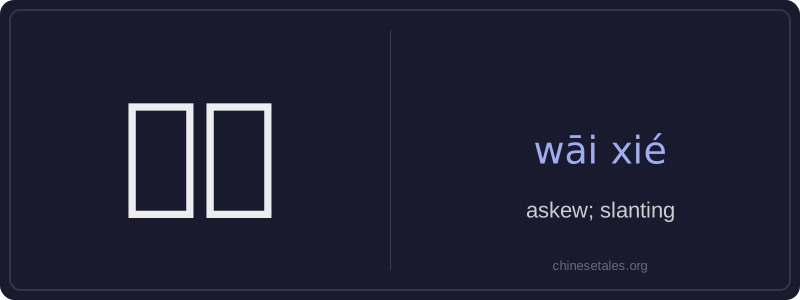
‘歪斜’ is a compound adjective meaning ‘askew’ or ‘slanting’—describing something that is not straight, level, or properly aligned. The first character 歪 (wāi) means ‘crooked’ or ‘awry’, often implying irregularity or deviation from the norm; the second character 斜 (xié) means ‘oblique’ or ‘inclined’, emphasizing angular deviation from vertical or horizontal. Together, they reinforce each other to describe an object or posture that leans, tilts, or is off-center in a noticeable, often slightly unnatural way.
This word is commonly used for physical objects (e.g., a leaning tower, a crooked picture frame), body postures (e.g., a head tilted sideways), or even abstract concepts like ‘distorted’ ideas—but its primary usage remains visual and spatial. It carries a neutral-to-slightly-negative tone, suggesting imperfection or instability, though not strongly pejorative. It’s more formal than colloquial alternatives like ‘歪了’ and is frequently found in written descriptions, technical reports, or careful speech.
Example Sentences
Related Words
国语
‘Guó yǔ’ literally means 'national language'—
无论谁
‘无论谁’ (wú lùn shéi) is a pronoun meaning
外语
‘外语’ literally means ‘outside language’ —
面条
‘面条’ (miàn tiáo) literally means ‘flour str
认同
‘认同’ (tóng rèn) is a verb meaning ‘to ident
不对
不对 (bù duì) literally combines 不 (bù), meani
认为
‘认为’ (rèn wéi) is a transitive verb meaning
违规
违规 (wéi guī) literally means 'to violate rules