Word Explanation
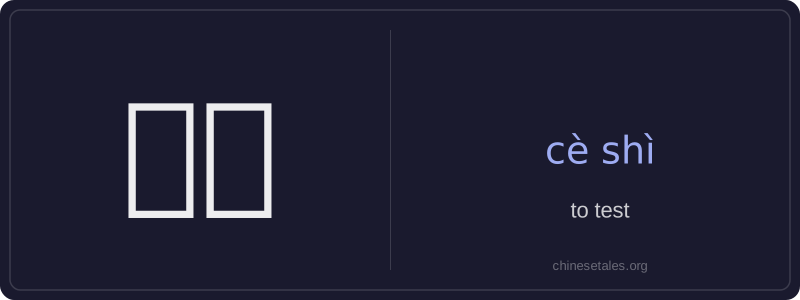
测试 (cè shì) is a verb meaning 'to test' or 'to examine'—often in contexts involving evaluation, verification, or assessment. The character 测 (cè) means 'to measure' or 'to estimate', while 试 (shì) means 'to try' or 'to attempt'. Together, they convey the idea of actively trying something out or measuring its performance, quality, or condition. It’s commonly used in academic, medical, technological, and professional settings—for example, testing software, taking an exam, or undergoing a medical screening.
Unlike the more casual 试 (shì) alone—which implies a light, exploratory 'try'—测试 suggests a structured, purposeful, and often formal process. It can also function as a noun ('a test') when preceded by a determiner like 这个 or 一次, e.g., 这个测试 (zhè ge cè shì, 'this test'). While it appears in everyday speech, it carries neutral-to-formal register and rarely occurs in highly colloquial or emotional expressions.
Example Sentences
Related Words
国语
‘Guó yǔ’ literally means 'national language'—
无论谁
‘无论谁’ (wú lùn shéi) is a pronoun meaning
外语
‘外语’ literally means ‘outside language’ —
面条
‘面条’ (miàn tiáo) literally means ‘flour str
认同
‘认同’ (tóng rèn) is a verb meaning ‘to ident
不对
不对 (bù duì) literally combines 不 (bù), meani
认为
‘认为’ (rèn wéi) is a transitive verb meaning
违规
违规 (wéi guī) literally means 'to violate rules