Word Explanation
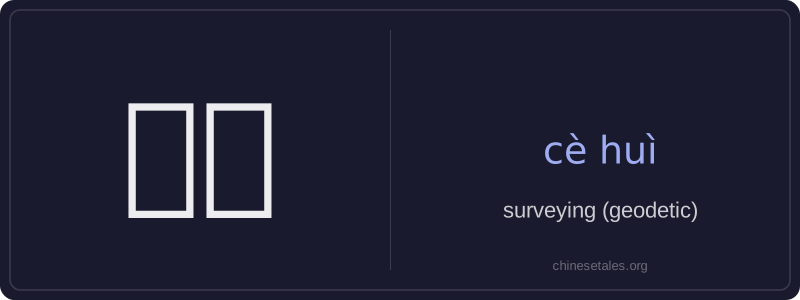
测绘 (cè huì) is a formal noun meaning 'surveying'—specifically geodetic or topographic surveying, the scientific process of measuring and mapping Earth's surface features, elevations, boundaries, and spatial relationships. The first character 测 (cè) means 'to measure' or 'to gauge', while 绘 (huì) means 'to draw' or 'to map'. Together, they literally convey 'measuring and mapping', reflecting the dual technical tasks at the heart of this discipline.
This term is used primarily in professional, technical, and governmental contexts—such as land management, urban planning, cartography, civil engineering, and geographic information systems (GIS). It is rarely used in everyday conversation and almost never appears in casual speech or informal writing. While related to general terms like 'mapping' or 'drawing', 测绘 emphasizes precision, scale, accuracy, and legal or scientific validity—distinguishing it from artistic drawing or simple sketching.
Example Sentences
Related Words
国语
‘Guó yǔ’ literally means 'national language'—
无论谁
‘无论谁’ (wú lùn shéi) is a pronoun meaning
外语
‘外语’ literally means ‘outside language’ —
面条
‘面条’ (miàn tiáo) literally means ‘flour str
认同
‘认同’ (tóng rèn) is a verb meaning ‘to ident
不对
不对 (bù duì) literally combines 不 (bù), meani
认为
‘认为’ (rèn wéi) is a transitive verb meaning
违规
违规 (wéi guī) literally means 'to violate rules