Word Explanation
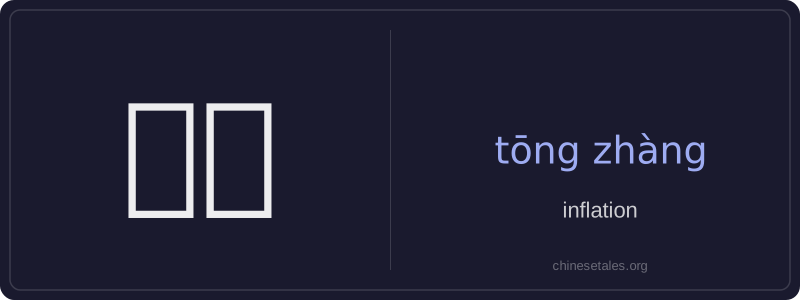
"通胀" is a concise, commonly used noun meaning "inflation" — the general rise in prices and fall in the purchasing value of money over time. The character 通 (tōng) here carries the sense of 'general' or 'widespread', while 胀 (zhàng) literally means 'swelling' or 'expansion', evoking the idea of prices 'swelling' across the economy. Together, they form a vivid, metaphorical compound that mirrors English's 'inflation' (from Latin 'inflare', to blow up).
This term appears frequently in news reports, economic discussions, policy documents, and everyday conversations about cost-of-living changes. It is almost always used as a standalone noun (e.g., 抗通胀, 高通胀), rarely as a verb. While formal in origin, it’s now fully integrated into spoken and written Mandarin — unlike the longer, more technical term 通货膨胀 (tōnghuò péngzhàng), which is its full form but less common in casual contexts.
Example Sentences
Related Words
国语
‘Guó yǔ’ literally means 'national language'—
无论谁
‘无论谁’ (wú lùn shéi) is a pronoun meaning
外语
‘外语’ literally means ‘outside language’ —
面条
‘面条’ (miàn tiáo) literally means ‘flour str
认同
‘认同’ (tóng rèn) is a verb meaning ‘to ident
不对
不对 (bù duì) literally combines 不 (bù), meani
认为
‘认为’ (rèn wéi) is a transitive verb meaning
违规
违规 (wéi guī) literally means 'to violate rules