Word Explanation
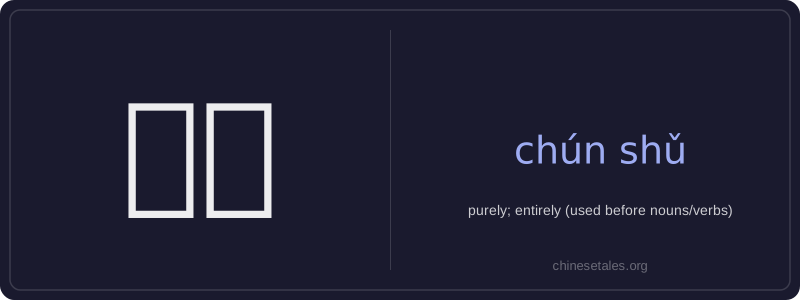
‘纯属’ is an adverbial phrase meaning 'purely,' 'entirely,' or 'solely.' It emphasizes that something is completely and exclusively of a certain nature, with no mixture or exception. The first character 纯 (chún) means 'pure' or 'unadulterated,' while 属 (shǔ) here functions as a verb meaning 'to belong to' or 'to be classified as' — together, they literally convey 'belongs purely to [X],' implying exclusivity and absoluteness.
This phrase is commonly used in formal or semi-formal speech and writing to downplay intention, deny responsibility, or stress objectivity — for example, when clarifying that an outcome was accidental or that a statement reflects no personal bias. It typically precedes nouns (e.g., 纯属误会 — 'purely a misunderstanding') or verbs (e.g., 纯属虚构 — 'entirely fictional'). It carries a slightly defensive or explanatory tone and is rarely used in casual, colloquial conversation.
Example Sentences
Related Words
国语
‘Guó yǔ’ literally means 'national language'—
无论谁
‘无论谁’ (wú lùn shéi) is a pronoun meaning
外语
‘外语’ literally means ‘outside language’ —
面条
‘面条’ (miàn tiáo) literally means ‘flour str
认同
‘认同’ (tóng rèn) is a verb meaning ‘to ident
违规
违规 (wéi guī) literally means 'to violate rules
不对
不对 (bù duì) literally combines 不 (bù), meani
认为
‘认为’ (rèn wéi) is a transitive verb meaning