Word Explanation
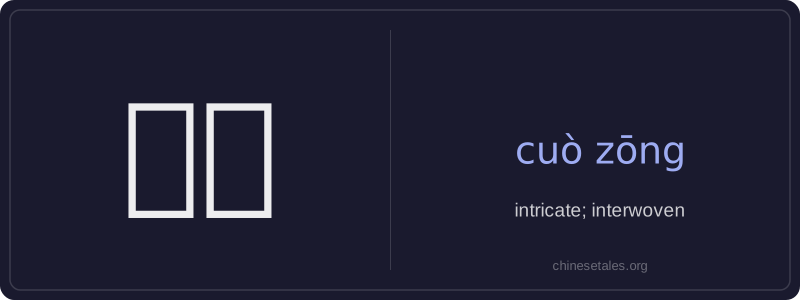
错综 (cuò zōng) is an adjective meaning 'intricate,' 'interwoven,' or 'complexly entangled.' Literally, 错 (cuò) means 'to interlace' or 'to be misplaced,' and 综 (zōng) means 'to weave together' or 'to integrate.' Together, they evoke the image of threads crossing and intertwining in a dense, non-linear pattern — like roots beneath a forest floor or vines climbing a trellis. The word emphasizes structural complexity and mutual interdependence rather than mere difficulty.
It's commonly used to describe natural systems (e.g., root networks, river deltas), abstract relationships (e.g., historical causes, social dynamics), or artistic compositions (e.g., embroidery, musical counterpoint). Though occasionally found in formal writing or academic contexts, it rarely appears in casual speech. It often pairs with nouns like 关系 (guānxi, 'relationships'), 结构 (jiégòu, 'structure'), or 现象 (xiànxiàng, 'phenomena') to highlight layered, non-hierarchical complexity.
Example Sentences
Related Words
国语
‘Guó yǔ’ literally means 'national language'—
无论谁
‘无论谁’ (wú lùn shéi) is a pronoun meaning
外语
‘外语’ literally means ‘outside language’ —
面条
‘面条’ (miàn tiáo) literally means ‘flour str
认同
‘认同’ (tóng rèn) is a verb meaning ‘to ident
违规
违规 (wéi guī) literally means 'to violate rules
亲笔
‘亲笔’ literally means ‘one’s own hand’—comb
不对
不对 (bù duì) literally combines 不 (bù), meani