Word Explanation
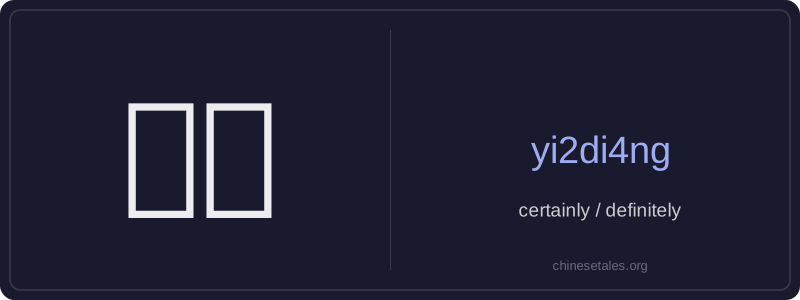
'一定' (yídìng) is an adverb meaning 'certainly', 'definitely', or 'for sure'. Literally, '一' means 'one' and '定' means 'to fix' or 'to decide', so together they convey the idea of something being firmly settled or unchangeable — hence certainty. It’s commonly used to express strong confidence in a statement, a promise, or an intention, often adding emphasis and sincerity.
This word frequently appears in spoken and written Chinese to strengthen assertions, make commitments ('I will definitely do it'), or reassure others ('It will certainly be fine'). It can also function as a noun meaning 'a certainty' (e.g., '这是一定的' — 'This is certain'), though this usage is less common for learners. Unlike English 'definitely', '一定' usually precedes the verb or adjective it modifies and cannot stand alone as a response without context.
Example Sentences
Related Words
我的
我的 (wǒ de) is a possessive pronoun meaning 'my'
红色的
红色的 (hóng sè de) is an adjective meaning 'red
学校的
'学校的' is a possessive phrase meaning 'school's'
大的
大的 (dà de) is the attributive form of the adjec
你的
你的 (nǐ de) is a possessive pronoun meaning 'you
妈妈的
'妈妈的' (mā ma de) is a possessive noun phrase m
一天
‘一天’ literally combines the numeral ‘一’ (y
一样
‘一样’ (yí yàng) literally combines ‘一’ (y