Word Explanation
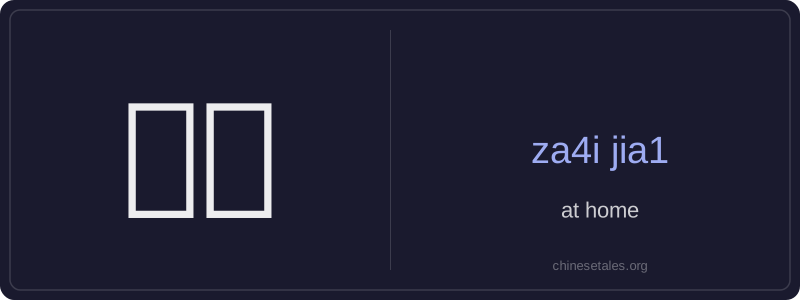
'Zài jiā' literally combines the preposition 'zài' (at, in, on) and the noun 'jiā' (home), forming a common locative phrase meaning 'at home'. It functions as an adverbial phrase indicating location or state of being, not a noun itself — you wouldn’t say 'I went to zài jiā'; instead, it modifies verbs to show where an action occurs or where someone is situated. It’s neutral in register and widely used across spoken and written Chinese.
This phrase appears frequently in daily conversations about routines, availability, or current status — for example, when explaining why someone isn’t answering the phone ('Tā zài jiā, dàn méi jiē diànhuà'), or describing habitual behavior ('Wǒ měi tiān wǎn shàng dōu zài jiā kàn shū'). Unlike standalone nouns, 'zài jiā' cannot take modifiers like 'zhè ge' or plural markers; it’s fixed and uninflected.
Example Sentences
Related Words
我的
我的 (wǒ de) is a possessive pronoun meaning 'my'
红色的
红色的 (hóng sè de) is an adjective meaning 'red
学校的
'学校的' is a possessive phrase meaning 'school's'
大的
大的 (dà de) is the attributive form of the adjec
你的
你的 (nǐ de) is a possessive pronoun meaning 'you
妈妈的
'妈妈的' (mā ma de) is a possessive noun phrase m
一天
‘一天’ literally combines the numeral ‘一’ (y
一样
‘一样’ (yí yàng) literally combines ‘一’ (y