Word Explanation
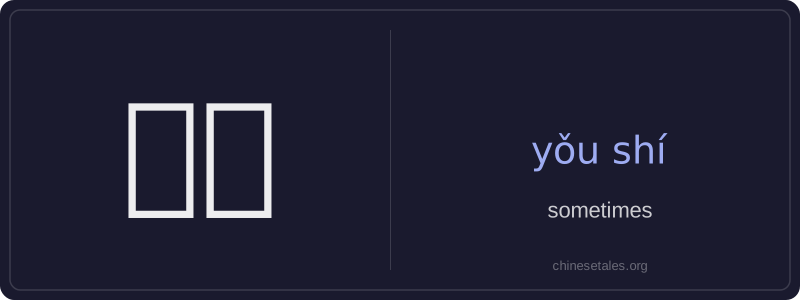
'有时' (yǒu shí) is an adverb meaning 'sometimes' — indicating that something happens occasionally, not always or never. Literally, it combines '有' (yǒu), meaning 'to have' or 'there is', and '时' (shí), meaning 'time'. Together, they convey the idea of 'there being times when...' — a compact, idiomatic way to express frequency in Mandarin. It’s neutral in register and widely used in both spoken and written Chinese.
This adverb typically appears at the beginning of a clause or before the verb, similar to English 'sometimes'. It implies irregularity or unpredictability in occurrence — for example, weather changes, mood fluctuations, or intermittent habits. Unlike more formal alternatives like '偶尔' (ǒu'ěr), '有时' feels natural in everyday conversation and carries no strong emotional connotation. It pairs well with verbs, adjectives, and stative predicates, but never modifies nouns directly.
Example Sentences
Related Words
我的
我的 (wǒ de) is a possessive pronoun meaning 'my'
中国
‘Zhōngguó’ literally means ‘Middle Kingdom’
一天
‘一天’ literally combines the numeral ‘一’ (y
在家
'Zài jiā' literally combines the preposition 'z
这边
这边 (zhè biān) literally combines 这 (zhè, 'th
中学
'Zhōngxué' literally combines 'zhōng' (middle)
红色的
红色的 (hóng sè de) is an adjective meaning 'red
不对
不对 (bù duì) literally combines 不 (bù), meani