Word Explanation
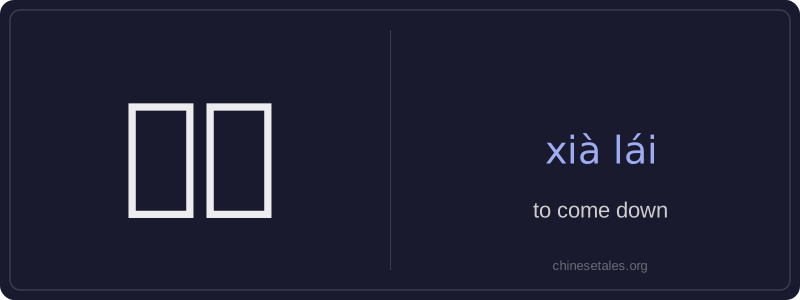
'下来' (xià lái) is a directional complement meaning 'to come down' or 'to descend'. It combines the verb 下 (xià, 'to go down') with the directional particle 来 (lái, 'toward the speaker'), indicating motion from a higher position toward the speaker’s location or a lower reference point. Unlike standalone verbs, it rarely appears alone—it typically follows another verb (e.g., 走下来, 跑下来, 拿下来) to specify downward direction and endpoint.
This structure emphasizes completion and arrival at a lower position—whether physically (e.g., descending stairs), metaphorically (e.g., prices falling), or temporally (e.g., events unfolding). It’s commonly used in daily life: giving directions, describing movement in buildings or mountains, reporting changes in data, or even in idiomatic expressions like '坚持下来' ('to persevere'). Context determines whether the meaning is literal or figurative, but the core sense of downward motion ending near the speaker or a defined lower point remains consistent.
Example Sentences
Related Words
中国
‘Zhōngguó’ literally means ‘Middle Kingdom’
我的
我的 (wǒ de) is a possessive pronoun meaning 'my'
一天
‘一天’ literally combines the numeral ‘一’ (y
在家
'Zài jiā' literally combines the preposition 'z
这边
这边 (zhè biān) literally combines 这 (zhè, 'th
这么
这么 (zhè me) is an adverb meaning 'so' or 'this
中学
'Zhōngxué' literally combines 'zhōng' (middle)
红色的
红色的 (hóng sè de) is an adjective meaning 'red