Word Explanation
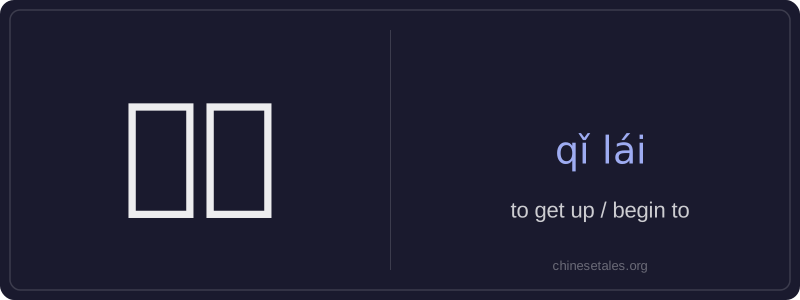
‘起来’ (qǐ lái) is a verb complement that primarily expresses the beginning or initiation of an action, or the physical act of rising from a lower position to a higher one—most commonly ‘to get up’ from bed or a seated position. The character 起 (qǐ) means ‘to rise’, ‘to start’, or ‘to lift’, while 来 (lái) adds directional meaning—‘toward the speaker’ or ‘into motion’. Together, they form a dynamic unit indicating upward movement or the onset of an activity.
This structure often follows verbs to signal the commencement of an action (e.g., 唱起来 ‘start singing’, 笑起来 ‘burst into laughter’) or stands alone as a main verb meaning ‘get up’ (e.g., 该起床了 ‘It’s time to get up’). It’s neutral in register and widely used in both spoken and written Chinese. Unlike standalone verbs, ‘起来’ rarely appears without a preceding verb or context indicating motion or change of state.
Example Sentences
Related Words
中国
‘Zhōngguó’ literally means ‘Middle Kingdom’
我的
我的 (wǒ de) is a possessive pronoun meaning 'my'
一天
‘一天’ literally combines the numeral ‘一’ (y
在家
'Zài jiā' literally combines the preposition 'z
这边
这边 (zhè biān) literally combines 这 (zhè, 'th
这么
这么 (zhè me) is an adverb meaning 'so' or 'this
中学
'Zhōngxué' literally combines 'zhōng' (middle)
红色的
红色的 (hóng sè de) is an adjective meaning 'red