Word Explanation
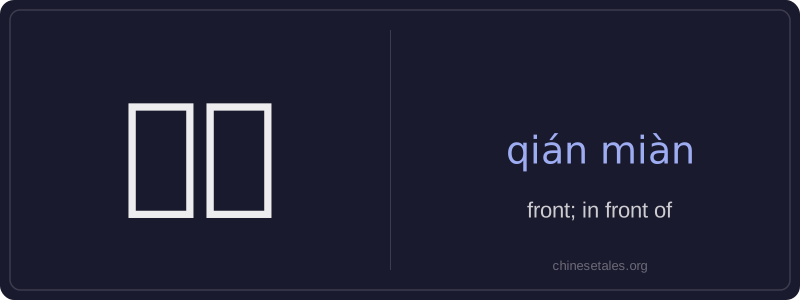
前面 (qián miàn) literally combines 前 (qián, 'front' or 'before') and 面 (miàn, 'side' or 'surface'), together meaning 'the front part' or 'in front of something.' As a noun, it refers to the front area — for example, the front of a building, a vehicle, or a person. As a preposition, it indicates position relative to another object: 'in front of X' (X being a noun or pronoun). It is commonly used in directional instructions, spatial descriptions, and everyday conversation about location.
This term is neutral in register and widely used across spoken and written Chinese. Unlike the more formal 前方 (qián fāng) or abstract 前头 (qián tou), 前面 is concrete, physical, and grounded in observable space. It often appears with location markers like 在 (zài) — e.g., 在前面 (zài qián miàn, 'at/in front') — but can also stand alone as a noun ('Go to the front').
Example Sentences
Related Words
我的
我的 (wǒ de) is a possessive pronoun meaning 'my'
中国
‘Zhōngguó’ literally means ‘Middle Kingdom’
一天
‘一天’ literally combines the numeral ‘一’ (y
在家
'Zài jiā' literally combines the preposition 'z
不对
不对 (bù duì) literally combines 不 (bù), meani
这边
这边 (zhè biān) literally combines 这 (zhè, 'th
中学
'Zhōngxué' literally combines 'zhōng' (middle)
红色的
红色的 (hóng sè de) is an adjective meaning 'red