Word Explanation
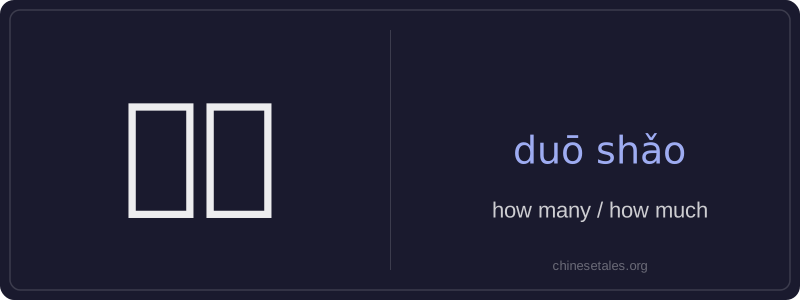
‘多少’ (duō shǎo) is a pronoun meaning ‘how many’ or ‘how much’, used to ask about quantity or amount. It combines the characters 多 (duō, ‘many’ or ‘much’) and 少 (shǎo, ‘few’ or ‘little’), forming an open-ended question word that covers the full range between extremes—essentially ‘how much on the scale from little to much?’. It’s neutral in register and appears frequently in everyday speech, especially when the speaker doesn’t know whether the answer will involve countable nouns (e.g., apples, people) or uncountable nouns (e.g., water, time, money).
It functions only in questions (or rhetorical statements) and never as a standalone noun or adjective. Unlike English, Chinese doesn’t change ‘多少’ for countability—it works for both: ‘多少人’ (how many people) and ‘多少钱’ (how much money). The answer usually includes a number plus a measure word (e.g., ‘三个人’, ‘二十块钱’), not just a bare numeral.
Example Sentences
Related Words
我的
我的 (wǒ de) is a possessive pronoun meaning 'my'
在家
'Zài jiā' literally combines the preposition 'z
中国
‘Zhōngguó’ literally means ‘Middle Kingdom’
红色的
红色的 (hóng sè de) is an adjective meaning 'red
一天
‘一天’ literally combines the numeral ‘一’ (y
不对
不对 (bù duì) literally combines 不 (bù), meani
这边
这边 (zhè biān) literally combines 这 (zhè, 'th
这么
这么 (zhè me) is an adverb meaning 'so' or 'this