Word Explanation
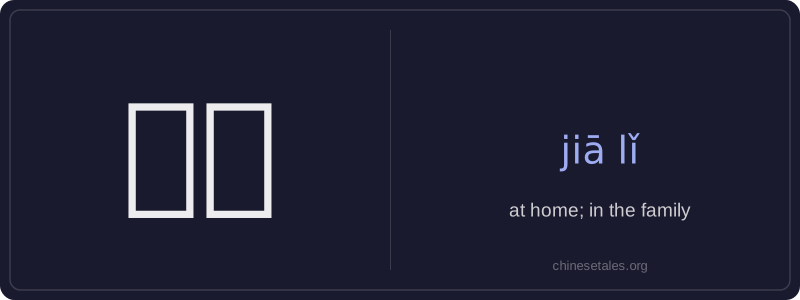
家里 (jiā lǐ) literally combines 家 (jiā), meaning 'home' or 'family', and 里 (lǐ), meaning 'inside' or 'within'. Together, it means 'at home' or 'in the family'—used primarily to indicate location (where something happens) or context (family-related matters). As a noun, it refers to one’s home as a physical place; as an adverb, it modifies verbs to show that an action occurs at home. It’s neutral in register and common in daily speech and writing.
The term emphasizes domestic space or familial relationships—not just the building, but the social unit. You’ll hear it when talking about routines ('I’m studying at home'), possessions ('My parents’ things are at home'), or family dynamics ('We discuss problems at home'). Unlike 家 (jiā) alone—which can mean 'home', 'family', or even 'household'—家里 always implies 'inside the home' or 'within the family sphere', never 'to home' or 'from home'.
Example Sentences
Related Words
我的
我的 (wǒ de) is a possessive pronoun meaning 'my'
在家
'Zài jiā' literally combines the preposition 'z
不对
不对 (bù duì) literally combines 不 (bù), meani
这边
这边 (zhè biān) literally combines 这 (zhè, 'th
中国
‘Zhōngguó’ literally means ‘Middle Kingdom’
中学
'Zhōngxué' literally combines 'zhōng' (middle)
红色的
红色的 (hóng sè de) is an adjective meaning 'red
一天
‘一天’ literally combines the numeral ‘一’ (y