Word Explanation
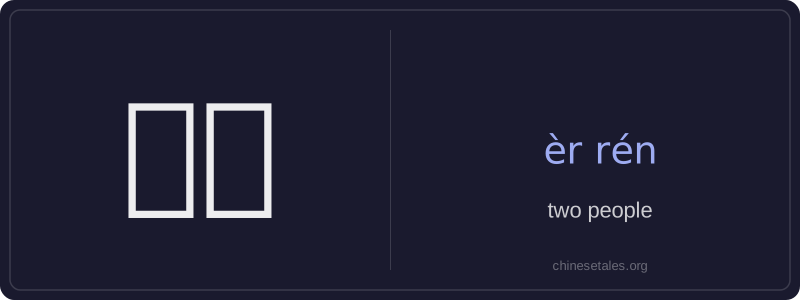
‘二人’ literally combines the numeral ‘二’ (èr, meaning ‘two’) and the noun ‘人’ (rén, meaning ‘person’ or ‘people’), forming a compound noun meaning ‘two people’. It is a neutral, concise term used to refer to any pair of individuals—whether friends, family members, colleagues, or strangers—and carries no inherent emotional or relational connotation. Unlike phrases like ‘两个人’ (liǎng gè rén), which uses the measure word ‘个’ and is more colloquial and flexible, ‘二人’ is slightly formal or literary, often appearing in written contexts, fixed expressions (e.g., 二人世界 ‘èr rén shì jiè’, ‘a world for two’), or official language.
This term emphasizes quantity and pairing rather than individual identity; it’s frequently used in contexts involving cooperation, interaction, or duality—such as duets, partnerships, or shared responsibilities. It does not imply gender, age, or relationship type unless specified by context. Learners should note that ‘二人’ cannot be pluralized or modified with adjectives directly—it functions as a complete noun unit and typically appears after determiners (e.g., 这二人 ‘zhè èr rén’, ‘these two people’) or in apposition.
Example Sentences
Related Words
我的
我的 (wǒ de) is a possessive pronoun meaning 'my'
一天
‘一天’ literally combines the numeral ‘一’ (y
在家
'Zài jiā' literally combines the preposition 'z
不对
不对 (bù duì) literally combines 不 (bù), meani
这边
这边 (zhè biān) literally combines 这 (zhè, 'th
中国
‘Zhōngguó’ literally means ‘Middle Kingdom’
中学
'Zhōngxué' literally combines 'zhōng' (middle)
红色的
红色的 (hóng sè de) is an adjective meaning 'red