Word Explanation
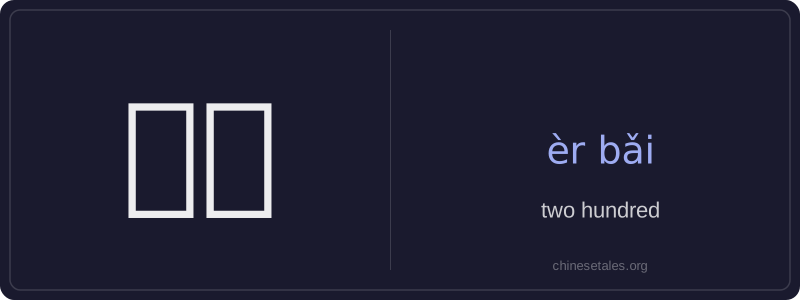
二百 (èr bǎi) is a numeral meaning 'two hundred' and functions as a cardinal number in Chinese. It combines the character 二 (èr), meaning 'two', and 百 (bǎi), meaning 'hundred'. Unlike English, Chinese numerals follow a strict multiplicative structure: the multiplier (èr) comes before the base unit (bǎi), with no word for 'and' or hyphenation. It is used in counting, measurements, prices, ages, and quantities — for example, '200 people', '200 yuan', or '200 years ago'.
This form is standard in both spoken and written Mandarin and appears frequently in daily contexts like shopping, travel, statistics, and time expressions. Note that 二百 is not used when stating years (e.g., '2023' is èr líng èr sān, not èr bǎi èr sān); for years, Chinese uses individual digits. Also, in formal writing or large numbers, 二百 may be replaced by 两百 (liǎng bǎi) before measure words, but 二百 remains common and correct in neutral contexts like standalone counts or after measure words like 个, 只, or 元.
Example Sentences
Related Words
我的
我的 (wǒ de) is a possessive pronoun meaning 'my'
一天
‘一天’ literally combines the numeral ‘一’ (y
在家
'Zài jiā' literally combines the preposition 'z
不对
不对 (bù duì) literally combines 不 (bù), meani
这边
这边 (zhè biān) literally combines 这 (zhè, 'th
中国
‘Zhōngguó’ literally means ‘Middle Kingdom’
中学
'Zhōngxué' literally combines 'zhōng' (middle)
红色的
红色的 (hóng sè de) is an adjective meaning 'red