Word Explanation
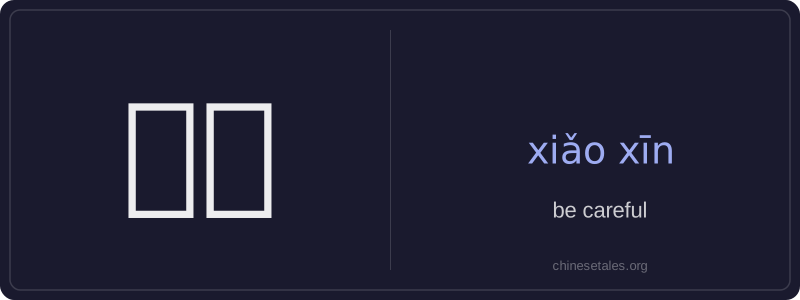
小心 literally means 'small heart'—a poetic, classical expression implying restraint and attentiveness, as if holding one’s heart gently to avoid rashness. Today, it functions primarily as a verb meaning 'to be careful' or 'to take precautions', and also as an adverb meaning 'carefully' or 'cautiously'. It’s used in warnings, instructions, and advice across everyday situations—from crossing the street to handling fragile objects.
The phrase is neutral in register and appropriate for all ages and contexts. While 小心 can stand alone as a complete imperative ('Be careful!'), it often appears with verbs (e.g., 小心走路 — 'walk carefully') or as a predicate (e.g., 这里很滑,要小心 — 'It’s slippery here; be careful'). Unlike formal terms like 谨慎, 小心 is warm, direct, and commonly heard in spoken Chinese, especially from parents, teachers, or friends offering gentle caution.
Example Sentences
Related Words
我的
我的 (wǒ de) is a possessive pronoun meaning 'my'
一天
‘一天’ literally combines the numeral ‘一’ (y
在家
'Zài jiā' literally combines the preposition 'z
不对
不对 (bù duì) literally combines 不 (bù), meani
这边
这边 (zhè biān) literally combines 这 (zhè, 'th
中国
‘Zhōngguó’ literally means ‘Middle Kingdom’
中学
'Zhōngxué' literally combines 'zhōng' (middle)
红色的
红色的 (hóng sè de) is an adjective meaning 'red