Word Explanation
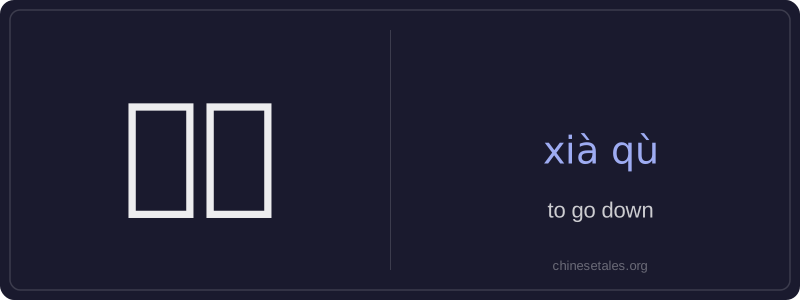
'Xià qù' literally combines 'xià' (down) and 'qù' (to go), forming a directional verb compound meaning 'to go down'—physically descending from a higher to a lower position. It emphasizes movement along a vertical axis, such as stairs, hills, slopes, or levels in a building. Unlike standalone 'xià', which can mean 'down' as a noun or adjective, 'xià qù' always implies motion toward a lower location and requires a subject performing the action.
This compound commonly follows subject–verb–object word order and often appears with location complements (e.g., '从楼上下去') or time/aspect markers like 'le' or 'guò'. It’s neutral in register—used in daily conversation, instructions, and written descriptions—but never stands alone as a command without context (e.g., you wouldn’t say just 'Xià qù!' unless the direction is already clear). It’s frequently paired with verbs like 'zǒu', 'pǎo', or 'tāng' to specify manner of descent.
Example Sentences
Related Words
我的
我的 (wǒ de) is a possessive pronoun meaning 'my'
这边
这边 (zhè biān) literally combines 这 (zhè, 'th
中国
‘Zhōngguó’ literally means ‘Middle Kingdom’
一天
‘一天’ literally combines the numeral ‘一’ (y
一心
‘一心’ literally combines ‘one’ (一) and ‘hea
在家
'Zài jiā' literally combines the preposition 'z
不对
不对 (bù duì) literally combines 不 (bù), meani
中学
'Zhōngxué' literally combines 'zhōng' (middle)