Word Explanation
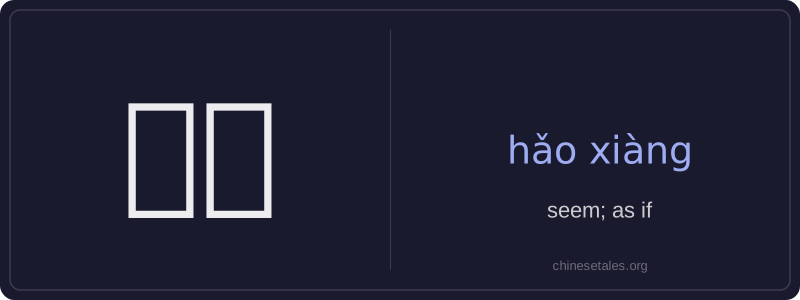
'好像' (hǎo xiàng) is an adverbial phrase meaning 'seem' or 'as if', used to express uncertainty, resemblance, or subjective impression. Literally, 好 (hǎo) means 'very' or 'quite', and 像 (xiàng) means 'to resemble' or 'like'; together they form a compound expressing that something appears to be true but isn’t confirmed — similar to English 'it looks like...', 'it seems that...', or 'as if'. It often introduces a clause describing what something resembles or how it appears.
This expression is common in spoken and written Mandarin across everyday conversations, storytelling, and descriptive writing. It conveys tentativeness without committing to factuality — for example, when making polite guesses ('You seem tired'), describing appearances ('The sky looks gray'), or introducing hypothetical comparisons ('He acts as if he owns the place'). It typically precedes verbs, adjectives, or full clauses, and never stands alone as a sentence.
Example Sentences
Related Words
我的
我的 (wǒ de) is a possessive pronoun meaning 'my'
这边
这边 (zhè biān) literally combines 这 (zhè, 'th
中国
‘Zhōngguó’ literally means ‘Middle Kingdom’
一天
‘一天’ literally combines the numeral ‘一’ (y
一心
‘一心’ literally combines ‘one’ (一) and ‘hea
在家
'Zài jiā' literally combines the preposition 'z
不对
不对 (bù duì) literally combines 不 (bù), meani
中学
'Zhōngxué' literally combines 'zhōng' (middle)