Word Explanation
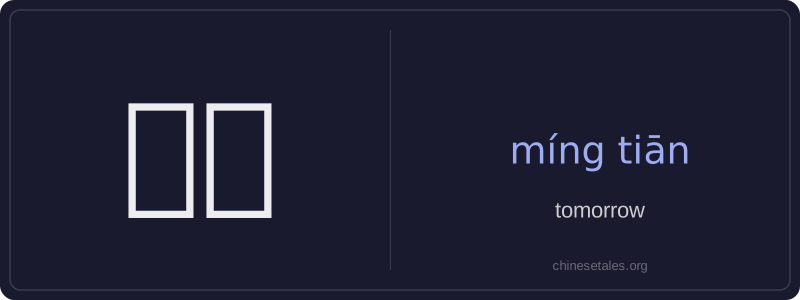
‘明天’ literally combines ‘明’ (bright, clear) and ‘天’ (sky, day), originally evoking the idea of the 'bright day' that follows today — hence, 'tomorrow'. It functions primarily as a noun meaning the day after today, but it also commonly serves as an adverb indicating when an action will occur ('tomorrow' in time expressions). It’s one of the most frequently used temporal words in daily conversation and appears in fixed phrases like 明天见 (see you tomorrow) and 明天再说 (let’s talk about it tomorrow).
The word is neutral in register — appropriate for casual speech, formal writing, and all social contexts. Unlike English, Chinese doesn’t use articles or verb conjugation with 明天; tense is inferred contextually. For example, both 我明天去学校 and 我明天要去学校 mean 'I’m going to school tomorrow', with the latter adding slight emphasis on intention or necessity.
Example Sentences
Related Words
我的
我的 (wǒ de) is a possessive pronoun meaning 'my'
这边
这边 (zhè biān) literally combines 这 (zhè, 'th
中国
‘Zhōngguó’ literally means ‘Middle Kingdom’
一天
‘一天’ literally combines the numeral ‘一’ (y
一心
‘一心’ literally combines ‘one’ (一) and ‘hea
在家
'Zài jiā' literally combines the preposition 'z
不对
不对 (bù duì) literally combines 不 (bù), meani
这么
这么 (zhè me) is an adverb meaning 'so' or 'this