Word Explanation
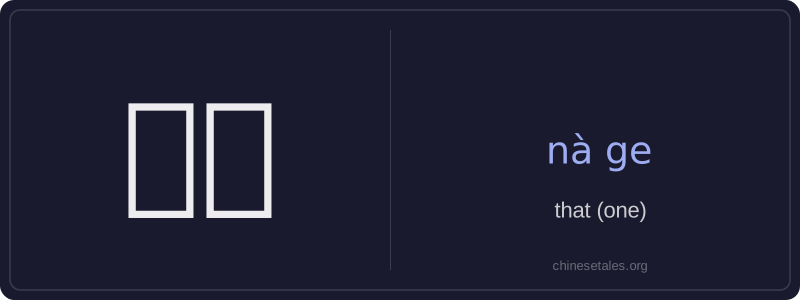
那个 (nà ge) is a demonstrative pronoun meaning 'that (one)' — used to point to a specific, previously mentioned or contextually clear noun that is not near the speaker. It combines 那 (nà), meaning 'that' (distant from speaker, medium distance from listener), and 个 (ge), a general classifier that softens the reference and makes it sound natural in speech. Unlike the more formal 那个 (nà gè) with tone-marked 个, the spoken form almost always uses neutral-tone ge, reflecting its grammatical function as a clitic rather than a standalone measure word.
This expression is extremely common in daily conversation and functions much like English 'that one' — often used when the noun is omitted but understood from context. It can refer to people, objects, ideas, or situations, and frequently appears in hesitation phrases ('um... that one...') or when distinguishing among options ('not this one, but that one'). It’s neutral in register and appropriate in both casual and semi-formal settings.
Example Sentences
Related Words
我的
我的 (wǒ de) is a possessive pronoun meaning 'my'
这边
这边 (zhè biān) literally combines 这 (zhè, 'th
中国
‘Zhōngguó’ literally means ‘Middle Kingdom’
一天
‘一天’ literally combines the numeral ‘一’ (y
一心
‘一心’ literally combines ‘one’ (一) and ‘hea
在家
'Zài jiā' literally combines the preposition 'z
不对
不对 (bù duì) literally combines 不 (bù), meani
这么
这么 (zhè me) is an adverb meaning 'so' or 'this