Word Explanation
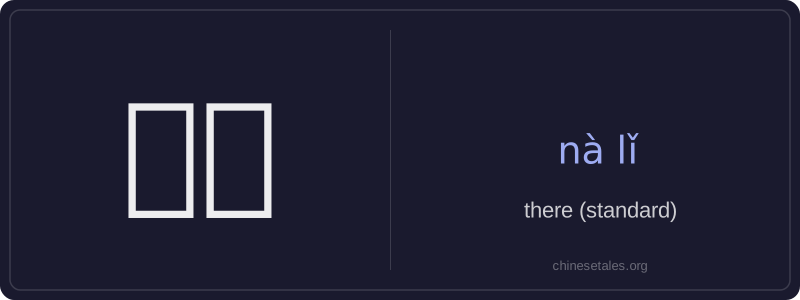
那里 (nà lǐ) is a demonstrative pronoun meaning 'there' — referring to a place that is distant from both the speaker and the listener. It combines 那 (nà), meaning 'that', and 里 (lǐ), meaning 'inside' or 'within', together forming a locative expression for a specific, non-proximal location. Unlike 这里 (zhè lǐ, 'here') or 那儿 (nàr, an informal variant), 那里 is standard, neutral in register, and commonly used in both spoken and written Chinese.
This word functions as a noun phrase and can serve as the subject, object, or complement in a sentence. It often appears after prepositions like 在 (zài, 'at/in') — e.g., 在那里 (zài nà lǐ, 'at that place') — though it may stand alone when context makes the location clear. It’s frequently used in directions, descriptions of locations, and narratives about distant or previously mentioned places.
Example Sentences
Related Words
我的
我的 (wǒ de) is a possessive pronoun meaning 'my'
这边
这边 (zhè biān) literally combines 这 (zhè, 'th
中国
‘Zhōngguó’ literally means ‘Middle Kingdom’
一天
‘一天’ literally combines the numeral ‘一’ (y
一心
‘一心’ literally combines ‘one’ (一) and ‘hea
在家
'Zài jiā' literally combines the preposition 'z
不对
不对 (bù duì) literally combines 不 (bù), meani
这么
这么 (zhè me) is an adverb meaning 'so' or 'this