Word Explanation
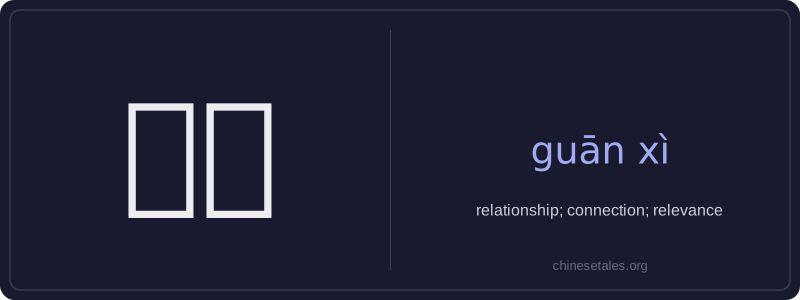
'关系' (guān xì) literally combines '关' (guān), meaning 'to connect, to involve', and '系' (xì), meaning 'to bind, to tie, or system'. Together, they form a noun meaning 'relationship'—whether interpersonal (e.g., family, friendship, business), causal ('connection'), or logical ('relevance'). It’s widely used in both formal and informal contexts, from describing personal ties ('他和经理有关系' — 'He has connections with the manager') to abstract linkages ('这和环保有什么关系?' — 'What’s the relevance to environmental protection?').
The word often appears after possessive markers (e.g., '我们的关系'), in questions about relevance ('有没有关系?'), or in fixed phrases like '没关系' (‘It doesn’t matter’) and '关系户' (‘a person who benefits from connections’). Unlike English ‘relationship’, '关系' rarely implies romantic involvement unless explicitly modified (e.g., '恋爱关系'). It carries subtle connotations of interdependence, influence, or mutual obligation—especially in social or professional settings.
Example Sentences
Related Words
我的
我的 (wǒ de) is a possessive pronoun meaning 'my'
这边
这边 (zhè biān) literally combines 这 (zhè, 'th
这么
这么 (zhè me) is an adverb meaning 'so' or 'this
中国
‘Zhōngguó’ literally means ‘Middle Kingdom’
一天
‘一天’ literally combines the numeral ‘一’ (y
一心
‘一心’ literally combines ‘one’ (一) and ‘hea
在家
'Zài jiā' literally combines the preposition 'z
不对
不对 (bù duì) literally combines 不 (bù), meani