Word Explanation
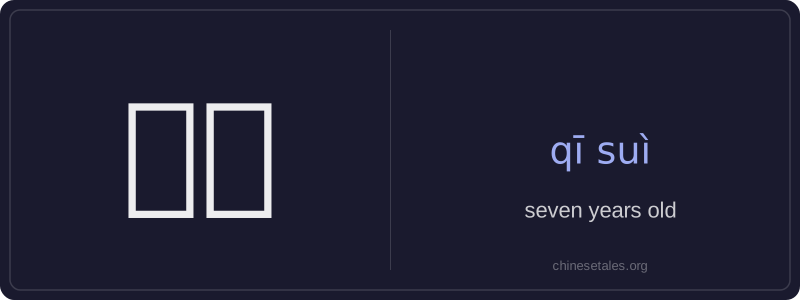
‘七岁’ literally means ‘seven years’ and functions as a noun meaning ‘seven years old’. The character 七 (qī) is the numeral ‘seven’, while 岁 (suì) specifically means ‘years of age’—it is used only for counting human age, never for objects or abstract time spans. Unlike English, Chinese does not use ‘years old’ as an adjective phrase; instead, ‘七岁’ stands alone as a nominal expression indicating a person’s age at a given time.
This term appears frequently in contexts describing childhood development, school enrollment, legal milestones (e.g., starting primary school), or family narratives. It is neutral in register and appropriate in both spoken and written Mandarin. Note that ‘岁’ cannot be omitted—saying just ‘七’ to mean ‘seven years old’ is incorrect and ambiguous (it could mean ‘seven items’ or ‘seven o’clock’). Age expressions in Chinese always require a measure word like 岁 for people, 周岁 for exact age, or 龄 in formal contexts.
Example Sentences
Related Words
我的
我的 (wǒ de) is a possessive pronoun meaning 'my'
这边
这边 (zhè biān) literally combines 这 (zhè, 'th
这么
这么 (zhè me) is an adverb meaning 'so' or 'this
中国
‘Zhōngguó’ literally means ‘Middle Kingdom’
一天
‘一天’ literally combines the numeral ‘一’ (y
一心
‘一心’ literally combines ‘one’ (一) and ‘hea
在家
'Zài jiā' literally combines the preposition 'z
不对
不对 (bù duì) literally combines 不 (bù), meani