Word Explanation
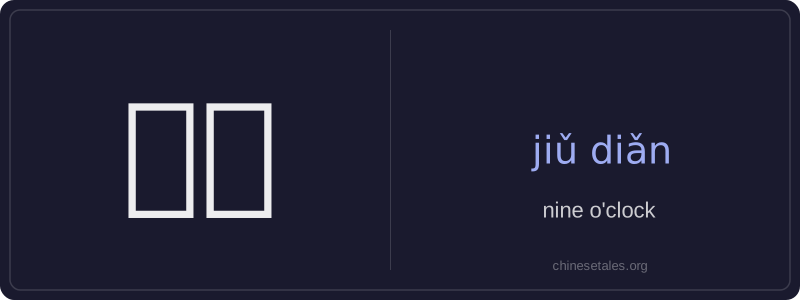
'九点' literally combines the numeral 九 (jiǔ, 'nine') and the noun 点 (diǎn, 'o'clock' or 'point in time'), forming a standard expression for 'nine o'clock'. It is used exclusively to indicate time on the hour — never with minutes unless modified (e.g., 九点一刻 for '9:15'). Unlike English, Chinese time expressions do not use colons or 'a.m./p.m.' distinctions; context or additional words like 上午 (shàngwǔ, 'morning') or 晚上 (wǎnshàng, 'evening') clarify whether it's 9 a.m. or 9 p.m.
This term appears frequently in daily scheduling — appointments, class times, TV broadcasts, and transportation timetables. It functions as a noun phrase and can serve as a subject, object, or time adverbial in sentences. While it looks like a compound word, its structure is transparent: numeral + time unit — a pattern shared by all hour expressions (e.g., 三点, 五点). Native speakers perceive it as a single temporal unit rather than two separate words in speech.
Example Sentences
Related Words
我的
我的 (wǒ de) is a possessive pronoun meaning 'my'
这边
这边 (zhè biān) literally combines 这 (zhè, 'th
这么
这么 (zhè me) is an adverb meaning 'so' or 'this
中国
‘Zhōngguó’ literally means ‘Middle Kingdom’
一天
‘一天’ literally combines the numeral ‘一’ (y
一心
‘一心’ literally combines ‘one’ (一) and ‘hea
在家
'Zài jiā' literally combines the preposition 'z
不对
不对 (bù duì) literally combines 不 (bù), meani