Word Explanation
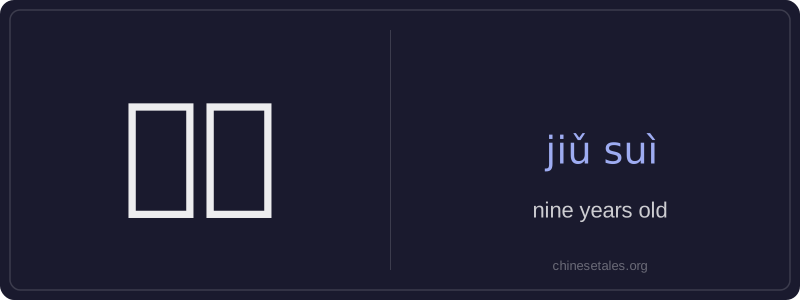
'九岁' (jiǔ suì) literally combines the numeral 九 (jiǔ, 'nine') and the measure word for age 岁 (suì, 'years old'). It functions as a noun meaning 'nine years old' and is used exclusively to state a person’s age—never for objects, animals, or abstract concepts. Unlike English, Chinese does not use 'years old' as a separate phrase; 岁 itself carries that meaning, so 九岁 is a complete, self-contained age expression.
This term appears in everyday contexts like introductions, school forms, medical records, or casual conversation about children. It follows standard age-naming conventions: number + 岁, with no article, verb, or modifier needed. It’s neutral in register—appropriate for formal documents and informal speech alike—and always refers to completed years of life (e.g., a child turns 九岁 on their ninth birthday, not after nine full years have passed).
Example Sentences
Related Words
我的
我的 (wǒ de) is a possessive pronoun meaning 'my'
这边
这边 (zhè biān) literally combines 这 (zhè, 'th
这么
这么 (zhè me) is an adverb meaning 'so' or 'this
中国
‘Zhōngguó’ literally means ‘Middle Kingdom’
一天
‘一天’ literally combines the numeral ‘一’ (y
一心
‘一心’ literally combines ‘one’ (一) and ‘hea
在家
'Zài jiā' literally combines the preposition 'z
不对
不对 (bù duì) literally combines 不 (bù), meani