Word Explanation
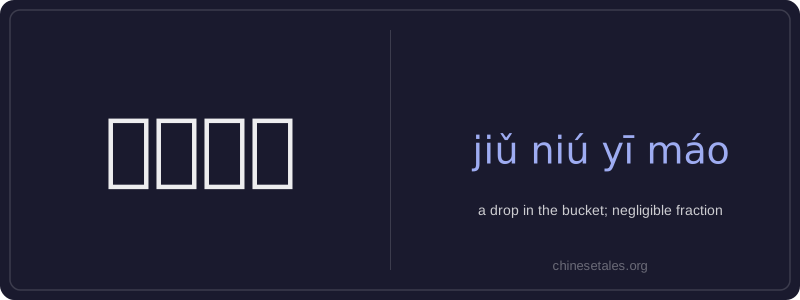
‘Jiǔ niú yī máo’ literally means 'nine oxen, one hair' — a vivid image illustrating something extremely small or insignificant in comparison to a much larger whole. The idiom uses hyperbole: even nine full-grown oxen together have countless hairs, so just one hair is utterly negligible. It emphasizes how trivial a quantity, effort, cost, or contribution is relative to the total scale involved.
This idiom is commonly used in contexts involving money, resources, time, or effort — for instance, when describing a minor expense compared to a huge budget, or a tiny loss amid massive gains. It carries a neutral-to-slightly formal tone and often appears in written Chinese, news reports, or analytical discussions. Unlike colloquial phrases, it’s rarely used in casual speech without rhetorical purpose, and it always functions as a noun phrase (often as the subject or object), never as a verb or modifier.
Example Sentences
Related Words
我的
我的 (wǒ de) is a possessive pronoun meaning 'my'
这边
这边 (zhè biān) literally combines 这 (zhè, 'th
这么
这么 (zhè me) is an adverb meaning 'so' or 'this
中国
‘Zhōngguó’ literally means ‘Middle Kingdom’
一天
‘一天’ literally combines the numeral ‘一’ (y
一心
‘一心’ literally combines ‘one’ (一) and ‘hea
在家
'Zài jiā' literally combines the preposition 'z
不对
不对 (bù duì) literally combines 不 (bù), meani