Word Explanation
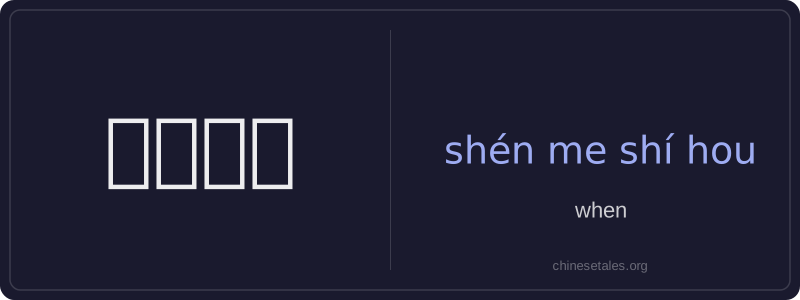
‘什么时候’ literally combines ‘shén me’ (what) and ‘shí hou’ (time), forming a question word meaning ‘when’. It functions as an adverbial interrogative, asking about the time of an event or action. Unlike English ‘when’, it always appears in questions — never as a conjunction (e.g., it cannot introduce subordinate clauses like ‘I’ll call you when I arrive’). It’s neutral in register and used in both spoken and written Mandarin.
The four characters work together as an inseparable unit: ‘什’ and ‘么’ form the interrogative ‘what’, while ‘时’ (time) and ‘候’ (a classical suffix indicating moment or period) combine to mean ‘time’ or ‘occasion’. Though ‘时候’ alone means ‘time’ or ‘moment’, adding ‘什么’ turns it into a specific temporal question word. It can refer to past, present, or future time — context determines tense.
Example Sentences
Related Words
我的
我的 (wǒ de) is a possessive pronoun meaning 'my'
这么
这么 (zhè me) is an adverb meaning 'so' or 'this
这边
这边 (zhè biān) literally combines 这 (zhè, 'th
中国
‘Zhōngguó’ literally means ‘Middle Kingdom’
中学
'Zhōngxué' literally combines 'zhōng' (middle)
一天
‘一天’ literally combines the numeral ‘一’ (y
一心
‘一心’ literally combines ‘one’ (一) and ‘hea
在家
'Zài jiā' literally combines the preposition 'z