Word Explanation
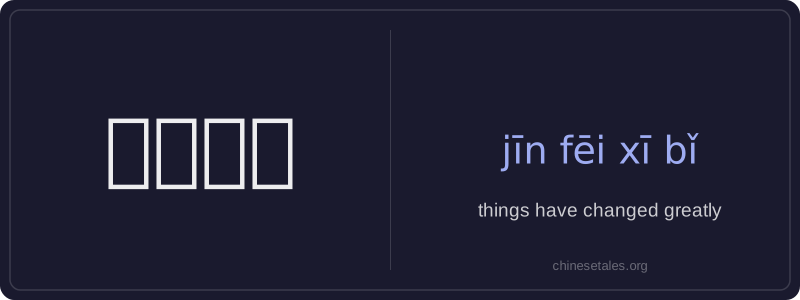
'Jīn fēi xī bǐ' literally means 'today is not like the past' — it expresses a dramatic, often positive, change over time. Each character contributes: 今 (jīn) means 'now/today', 非 (fēi) means 'not', 昔 (xī) means 'past/former times', and 比 (bǐ) means 'to compare'. Together, they form a classical four-character idiom emphasizing contrast between present and past states.
This idiom is commonly used in spoken and written Chinese to highlight improvement — such as in personal growth, technological progress, urban development, or social conditions. It carries a tone of admiration or relief, and is typically placed at the end of a sentence or as a standalone comment after describing the change. While neutral in formality, it’s more frequent in semi-formal or narrative contexts than in casual texting or slang.
Example Sentences
Related Words
我的
我的 (wǒ de) is a possessive pronoun meaning 'my'
这么
这么 (zhè me) is an adverb meaning 'so' or 'this
这边
这边 (zhè biān) literally combines 这 (zhè, 'th
中国
‘Zhōngguó’ literally means ‘Middle Kingdom’
中学
'Zhōngxué' literally combines 'zhōng' (middle)
一天
‘一天’ literally combines the numeral ‘一’ (y
一心
‘一心’ literally combines ‘one’ (一) and ‘hea
在家
'Zài jiā' literally combines the preposition 'z