Word Explanation
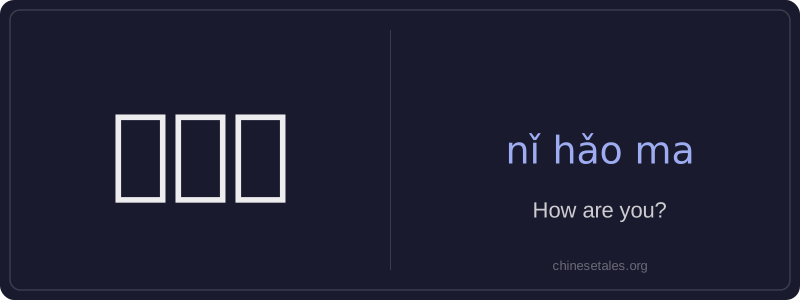
'Nǐ hǎo ma?' is a standard, polite greeting in Chinese that literally combines the pronoun 'nǐ' (you), the adjective 'hǎo' (good/well), and the sentence-final question particle 'ma', which turns any statement into a yes-no question. Though it looks like a literal translation of 'You good?', it functions idiomatically as 'How are you?'—a friendly, open-ended inquiry about someone's general well-being or current state.
This phrase is most common in casual to semi-formal spoken interactions—between friends, classmates, colleagues, or when meeting acquaintances. It’s rarely used in writing except in dialogue or informal digital communication. Unlike English, Chinese speakers often don’t expect a detailed response; a simple 'Wǒ hěn hǎo, xièxie' (I’m very well, thank you) suffices. Tone is important: 'ma' is neutral (light tone), not third tone—pronouncing it as 'mǎ' would sound unnatural or even humorous.
Example Sentences
Related Words
我的
我的 (wǒ de) is a possessive pronoun meaning 'my'
这么
这么 (zhè me) is an adverb meaning 'so' or 'this
这边
这边 (zhè biān) literally combines 这 (zhè, 'th
中国
‘Zhōngguó’ literally means ‘Middle Kingdom’
中学
'Zhōngxué' literally combines 'zhōng' (middle)
一天
‘一天’ literally combines the numeral ‘一’ (y
一心
‘一心’ literally combines ‘one’ (一) and ‘hea
在家
'Zài jiā' literally combines the preposition 'z