Word Explanation
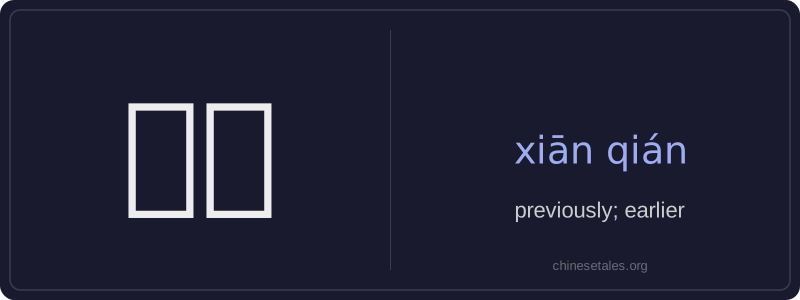
先前 is an adverb meaning 'previously' or 'earlier'—it refers to a time before the present moment or before another point in time mentioned in context. Though it contains two characters, 先 (xiān) meaning 'first' or 'before', and 前 (qián) meaning 'front' or 'before', together they form a fixed compound emphasizing temporal precedence—not spatial position. It’s commonly used in both spoken and written Chinese, especially in narratives, explanations, or comparisons involving time sequences.
The word often appears at the beginning of a clause or sentence, followed by a verb or state description. Unlike some time words (e.g., 以前), 先前 tends to be slightly more formal or literary and usually implies a relatively recent past—often within the same discourse or situation, rather than a distant or indefinite past. It’s not used with duration markers like 了 or 过 in the same way as verbs; instead, it modifies the entire event or state that follows.
Example Sentences
Related Words
我的
我的 (wǒ de) is a possessive pronoun meaning 'my'
这么
这么 (zhè me) is an adverb meaning 'so' or 'this
这边
这边 (zhè biān) literally combines 这 (zhè, 'th
中国
‘Zhōngguó’ literally means ‘Middle Kingdom’
中学
'Zhōngxué' literally combines 'zhōng' (middle)
一天
‘一天’ literally combines the numeral ‘一’ (y
一心
‘一心’ literally combines ‘one’ (一) and ‘hea
在家
'Zài jiā' literally combines the preposition 'z