Word Explanation
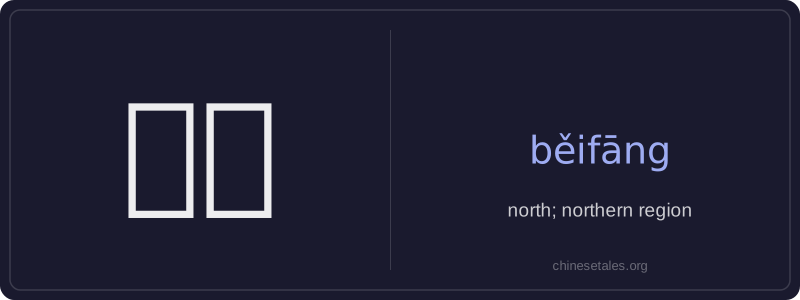
北方 literally means 'north direction' — 北 (běi) means 'north', and 方 (fāng) means 'direction' or 'region'. Together, they refer to the northern part of a country, area, or geographical space. In Chinese, 北方 is commonly used to describe geographic location, climate, culture, or origin — for example, people might say '北方人' (people from the north) or '北方菜' (northern cuisine). It functions as a noun and often appears with classifiers like '中国北方' (northern China) or '华北北方' (North China).
Unlike the English word 'north', which can be an adverb ('go north'), 北方 is almost always a noun and does not function adverbially. It rarely stands alone without context — you’ll usually see it modified by another noun (e.g., '南方和北方' — south and north) or preceded by a location (e.g., '俄罗斯北方' — northern Russia). It carries neutral formality and is appropriate in both spoken and written contexts.
Example Sentences
Related Words
我的
我的 (wǒ de) is a possessive pronoun meaning 'my'
这么
这么 (zhè me) is an adverb meaning 'so' or 'this
这边
这边 (zhè biān) literally combines 这 (zhè, 'th
中国
‘Zhōngguó’ literally means ‘Middle Kingdom’
中学
'Zhōngxué' literally combines 'zhōng' (middle)
一天
‘一天’ literally combines the numeral ‘一’ (y
一心
‘一心’ literally combines ‘one’ (一) and ‘hea
在家
'Zài jiā' literally combines the preposition 'z