Word Explanation
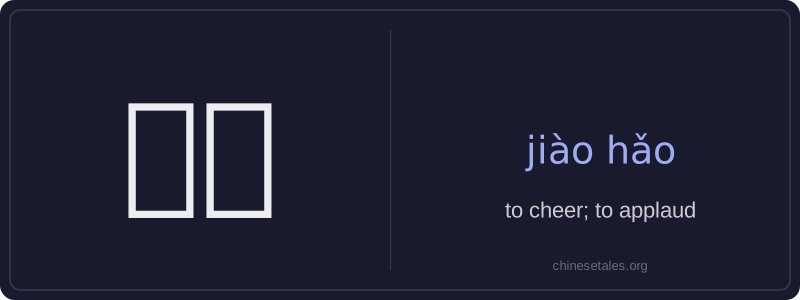
‘叫好’ is a verb meaning ‘to cheer’ or ‘to applaud’—literally ‘to call good’. The first character 叫 means ‘to call’ or ‘to shout’, and the second character 好 means ‘good’. Together, they express vocal approval, typically in live settings like performances, speeches, or sports events. It emphasizes enthusiastic, audible praise rather than silent appreciation.
This term is commonly used in contexts where an audience expresses collective approval: theatergoers might 叫好 after a dazzling acrobatic stunt; students may 叫好 when a classmate gives a witty answer. While it can be used transitively (e.g., 叫好声不断), it’s most frequently intransitive and appears in phrases like 现场观众纷纷叫好 (the live audience cheered repeatedly). It carries a warm, lively connotation and is neutral in register—suitable for both spoken and written descriptions of public enthusiasm.
Example Sentences
Related Words
我的
我的 (wǒ de) is a possessive pronoun meaning 'my'
这么
这么 (zhè me) is an adverb meaning 'so' or 'this
这边
这边 (zhè biān) literally combines 这 (zhè, 'th
中国
‘Zhōngguó’ literally means ‘Middle Kingdom’
中学
'Zhōngxué' literally combines 'zhōng' (middle)
一天
‘一天’ literally combines the numeral ‘一’ (y
一心
‘一心’ literally combines ‘one’ (一) and ‘hea
在家
'Zài jiā' literally combines the preposition 'z