Word Explanation
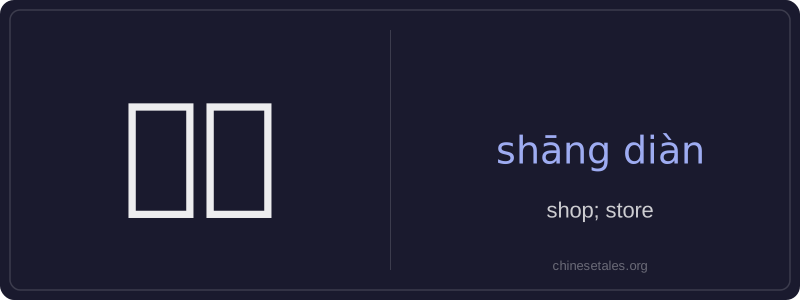
'Shāngdiàn' literally combines 'shāng' (commerce, business) and 'diàn' (shop, establishment), forming a general, neutral term for any retail location where goods or services are sold. It’s widely used in everyday speech and writing across China and other Mandarin-speaking regions, applicable to small family-run shops, convenience stores, boutiques, and even large department stores — though for very large ones, 'bǎi huò gōng sī' (department store) may be more precise.
Unlike more specific terms like 'chāo shì' (supermarket) or 'xiǎo mài bù' (convenience store), 'shāngdiàn' carries no inherent size or product-type connotation. It’s slightly more formal than colloquial alternatives like 'diàn' alone but remains common in both spoken and written Chinese. You’ll see it on signs, in directions ('near the bookstore'), and in simple descriptions of daily activities ('I went to the shop to buy milk').
Example Sentences
Related Words
我的
我的 (wǒ de) is a possessive pronoun meaning 'my'
这么
这么 (zhè me) is an adverb meaning 'so' or 'this
这边
这边 (zhè biān) literally combines 这 (zhè, 'th
中国
‘Zhōngguó’ literally means ‘Middle Kingdom’
中学
'Zhōngxué' literally combines 'zhōng' (middle)
见面
见面 literally means 'see face' — combining 见 (t
后来
Later (hòulái) is an adverb meaning 'afterwards'
背后
背后 literally means 'back + behind' and functions